

March 2024
2024-03-04 Josefstadt Leben und Sterben in Wien
Production photographs documenting Herbert Föttinger's 2024 premiere staging of Thomas Arzt's *Leben und Sterben in Wien* at Theater in der Josefstadt, Vienna. The images record key theatrical moments from this interwar period drama featuring Katharina Klar as the maid Fanni, Johanna Mahaffy as the socialist Sara, Jakob Elsenwenger as Hans, and Robert Joseph Bartl as the Priest. Scenic design by Die Schichtarbeiter employs minimalist staging with projected landscapes, stark chiaroscuro lighting, and atmospheric effects including snow and fog. Costumes by Birgit Hutter establish the 1920s-30s Viennese setting. The photographs capture ensemble configurations, intimate dialogues, confrontational tableaux, and climactic scenes depicting political radicalization and social violence characteristic of Austria's Zwischenkriegszeit, including death scenes and symbolic imagery exploring themes of mortality and ideological conflict.
41 photos
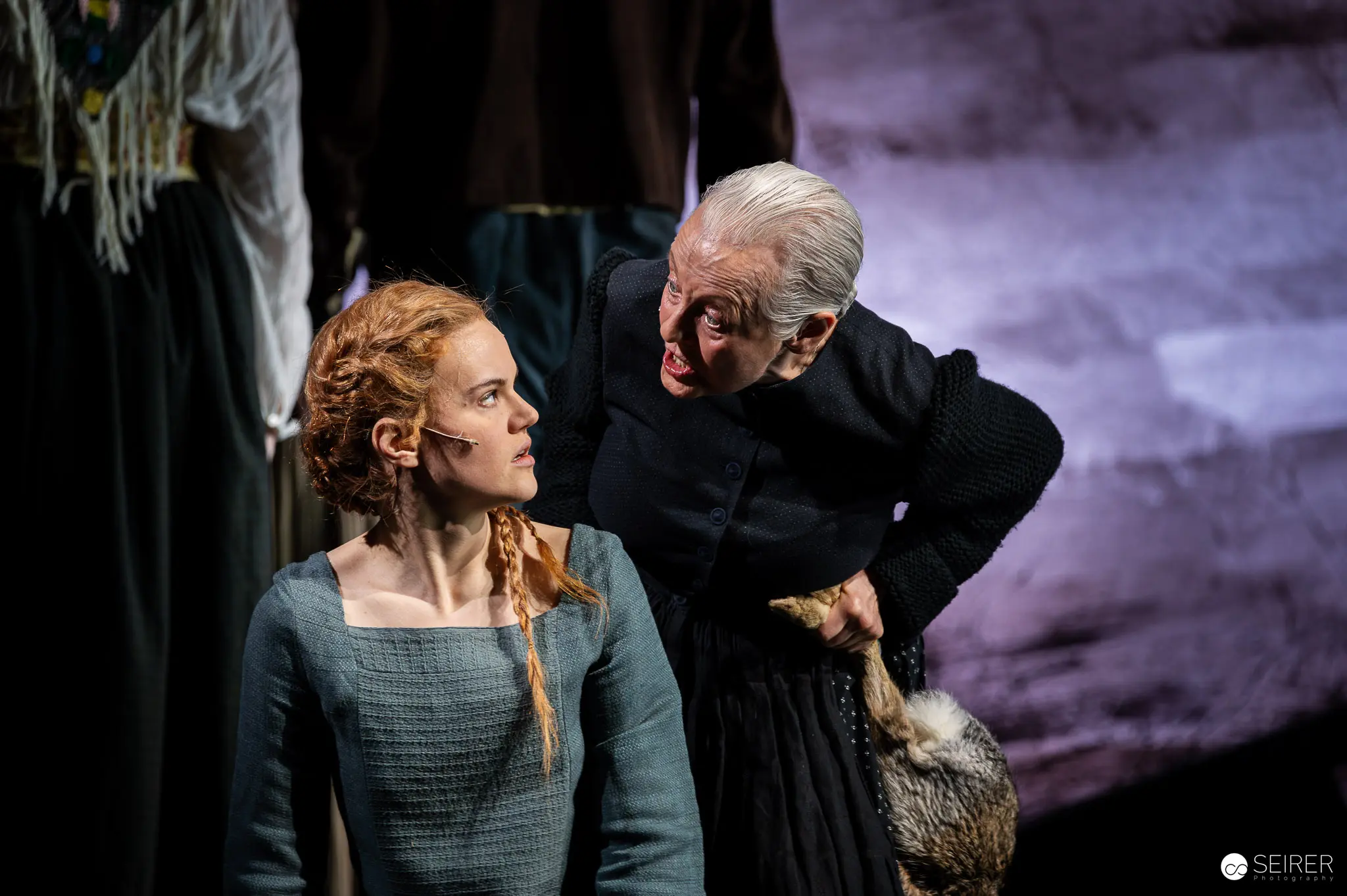
"Leben und Sterben in Wien" Theater in der Josefstadt, 2024 Two performers occupy the foreground of a theatrical stage against a backdrop depicting a wintry landscape. The younger actress at left, wearing a teal period dress with her auburn hair in a long braid, directs her gaze toward the older performer at right, who leans in conversationally while dressed in black clerical garments and holding what appears to be a rope or cord. This scene from Thomas Arzt's *Leben und Sterben in Wien*, staged at Theater in der Josefstadt in 2024 under Herbert Föttinger's direction, positions the characters in an intimate dialogue within a spare theatrical setting enhanced by projected scenography. The composition suggests a moment of counsel or confrontation between the figures. 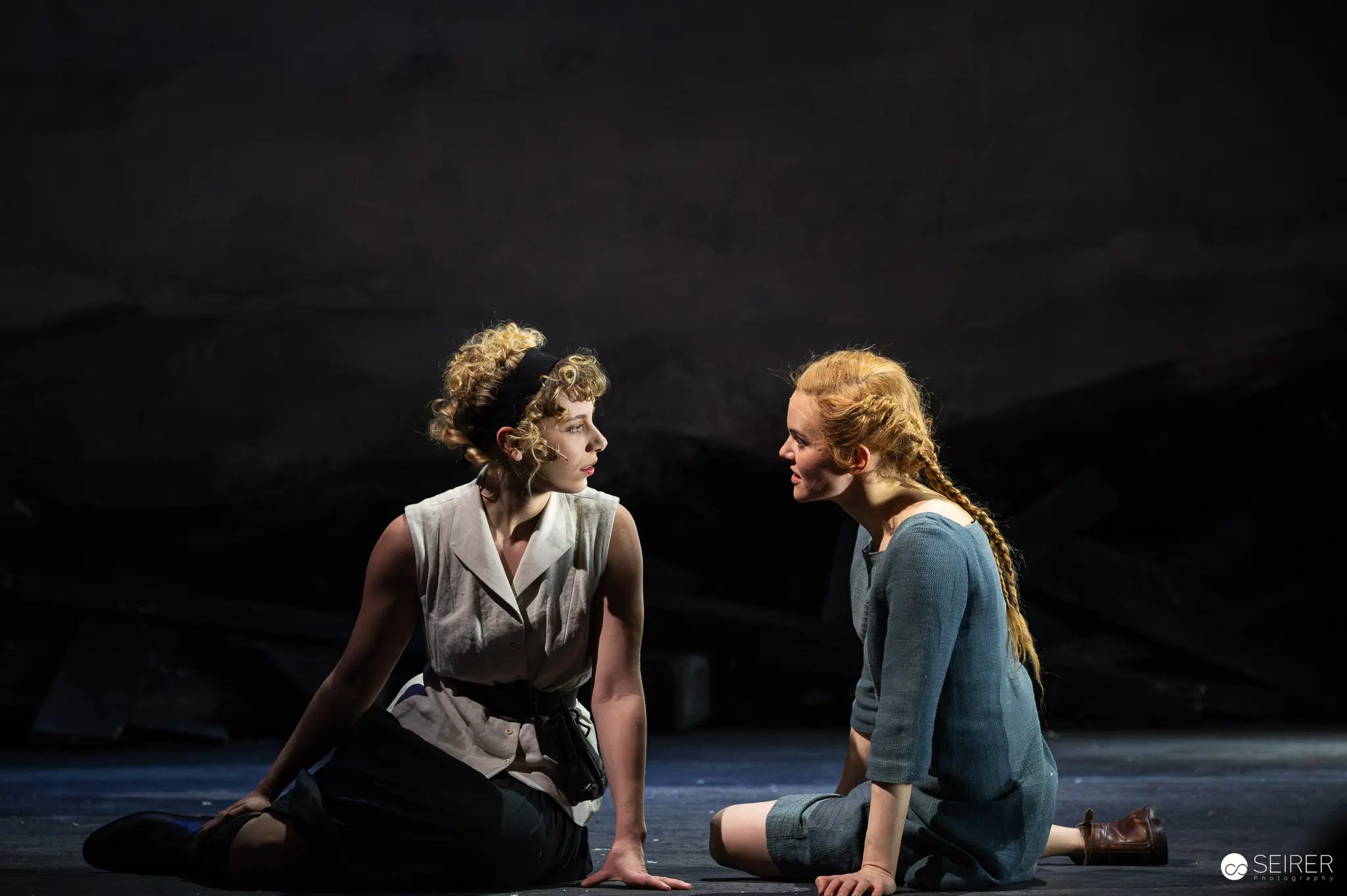 "Leben und Sterben in Wien" Theater in der Josefstadt, 2024 Two female performers are positioned on stage in a dimly lit scene, seated on the floor facing each other against a dark backdrop with subtle atmospheric lighting. The figure on the left wears a white sleeveless top with a dark belt and has her hair styled in an upswept arrangement, while the figure on the right wears a blue-gray long-sleeved garment with her hair in a long braid. This production photograph from Herbert Föttinger's 2024 staging of Thomas Arzt's *Leben und Sterben in Wien* at Theater in der Josefstadt depicts Katharina Klar as the maid Fanni and Johanna Mahaffy as the socialist Sara, whose encounter forms the dramatic catalyst of this interwar Vienna period drama. The minimalist stage design by Die Schichtarbeiter emphasizes the interpersonal dynamic between the two characters.
 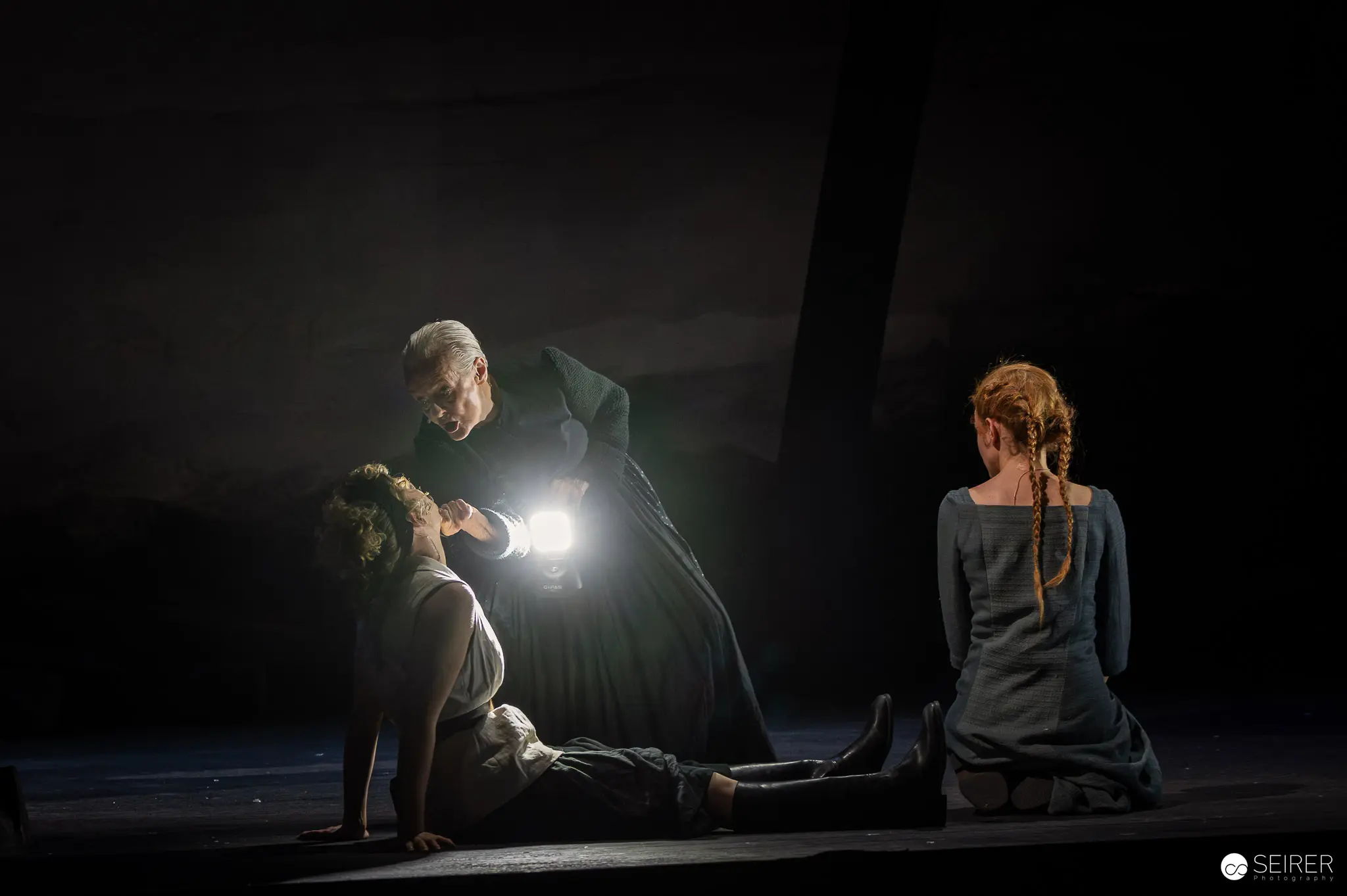 "Leben und Sterben in Wien" Theater in der Josefstadt, 2024 Three figures occupy a darkly lit stage space, illuminated by a single beam of light from above. A woman in dark period dress sits on the floor at right, her back to the viewer with hair in a long braid, while two other figures are positioned to the left—one seated on the ground, another standing and leaning forward, both dressed in muted tones. The stark chiaroscuro lighting and minimal staging reflects Die Schichtarbeiter's scenic design for Herbert Föttinger's 2024 production of Thomas Arzt's *Leben und Sterben in Wien* at Theater in der Josefstadt, establishing the austere atmosphere of interwar Vienna that frames this historical drama.
 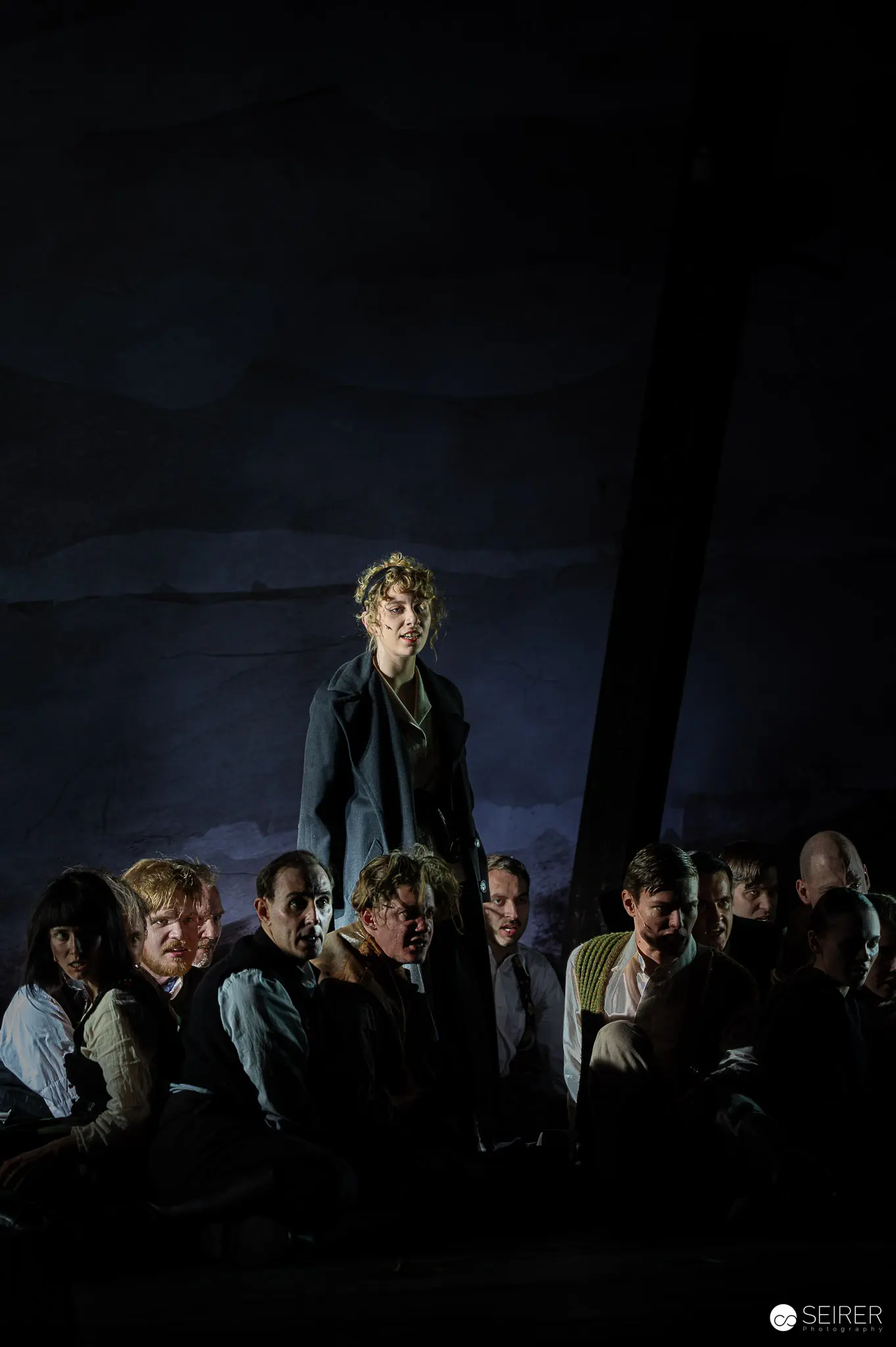 "Leben und Sterben in Wien" Theater in der Josefstadt, 2024 A darkened theatrical scene from *Leben und Sterben in Wien* at Theater in der Josefstadt shows a single illuminated figure standing elevated above a gathered ensemble of performers in period costume. The composition creates a striking vertical hierarchy, with the central figure in dark clothing positioned against dim blue-grey atmospheric lighting, while approximately nine actors in working-class attire of the interwar period cluster in the foreground, their faces lit to varying degrees. The minimalist staging by Die Schichtarbeiter emphasizes the social stratification central to Thomas Arzt's drama, with the spatial arrangement suggesting themes of leadership, address, or political assembly characteristic of 1920s-30s Vienna's turbulent class dynamics.
 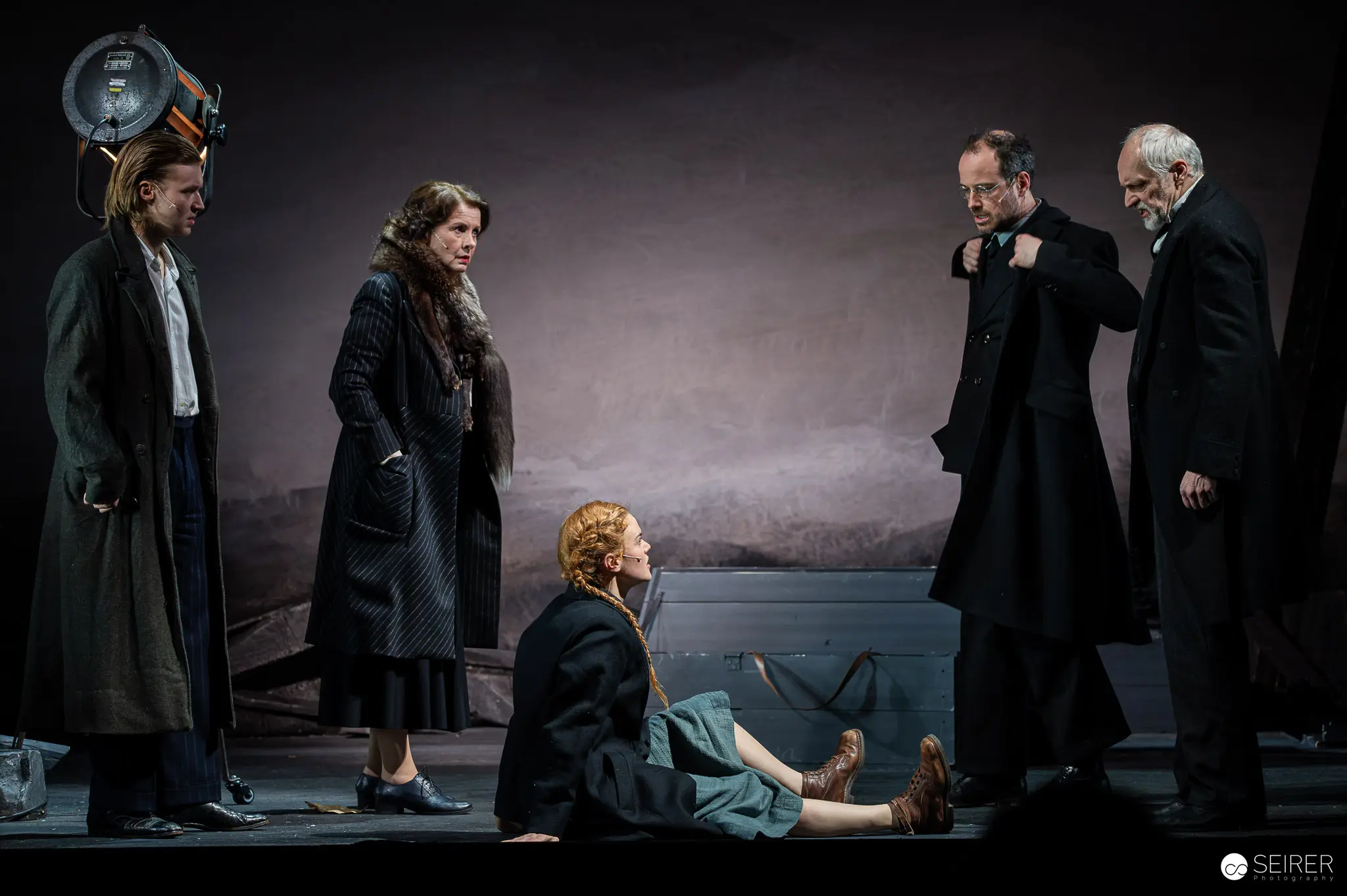 "Leben und Sterben in Wien" Theater in der Josefstadt, 2024 A theatrical tableau from "Leben und Sterben in Wien" showing six performers arranged around a prone figure on a dark stage platform. The composition divides into two groups: on the left, a figure with an elaborate headdress stands beside Katharina Klar as Fanni in dark period costume; on the right, three men in black coats form a cluster, while a figure with blonde hair lies supine in pale blue-green garments at center. The scene is illuminated against a neutral backdrop, emphasizing the stark spatial geometry and somber palette characteristic of Die Schichtarbeiter's scenic design for Herbert Föttinger's production at Theater in der Josefstadt.
 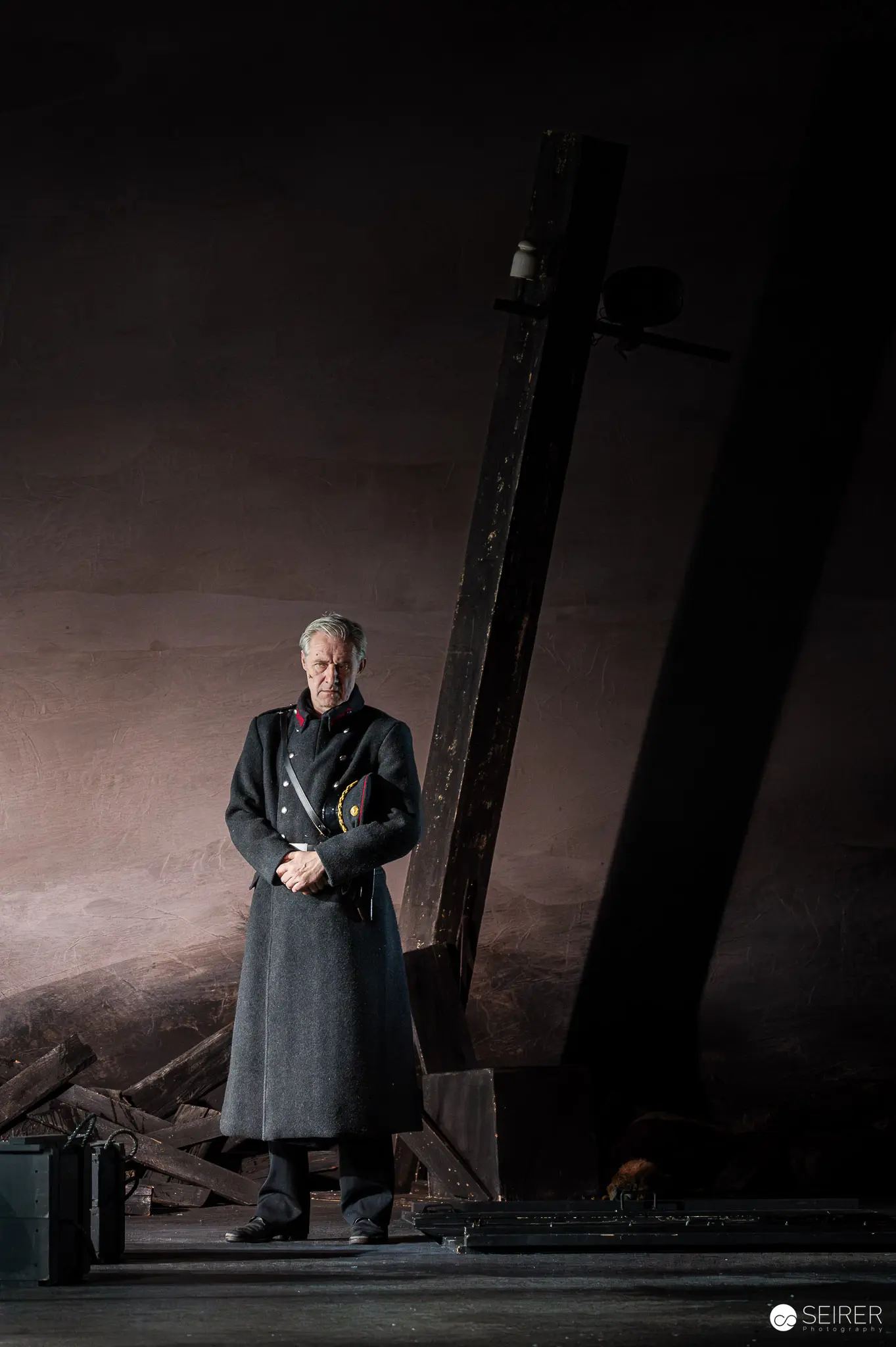 "Leben und Sterben in Wien" Theater in der Josefstadt, 2024 A single figure in clerical attire stands in stage left medium shot against a dramatically lit architectural backdrop featuring a large diagonal beam or ladder ascending into darkness. The performer, positioned on wooden planking, wears a long black cassock with white liturgical stole, hands clasped at waist level in a posture suggesting religious authority or contemplation. The lighting scheme creates a strong chiaroscuro effect, with warm illumination from below contrasting against the deep shadows of the upper stage area, emphasizing the vertical compositional elements. This production photograph documents *Leben und Sterben in Wien* at Theater in der Josefstadt, directed by Herbert Föttinger with scenic design by Die Schichtarbeiter, depicting Robert Joseph Bartl in the role of the Priest within the 2024 premiere production.
 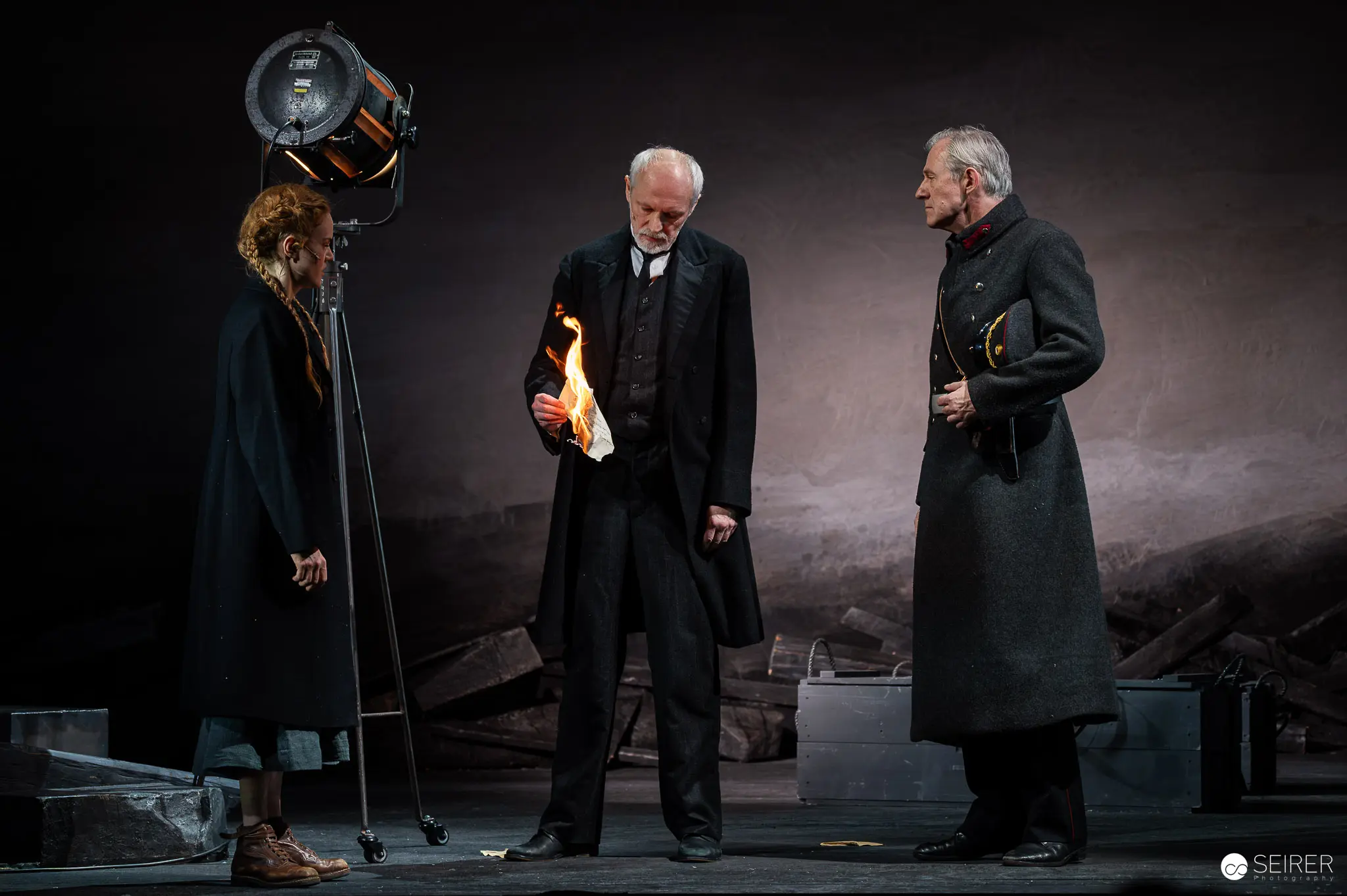 "Leben und Sterben in Wien" Theater in der Josefstadt, 2024 Three figures occupy a sparse theatrical stage against a misty, mountainous backdrop in this scene from "Leben und Sterben in Wien" at Theater in der Josefstadt. At left, an actress in a dark cloak stands beside a vintage standing microphone, while two men in long black coats engage in conversation at center and right, one holding what appears to be a burning torch or flame. The minimalist staging features geometric blocks scattered across the floor, with dramatic lighting creating a somber, expressionistic atmosphere characteristic of interwar period drama. The composition emphasizes the tension between individual figures through spatial separation and the stark contrast of fire against the darkened set.
 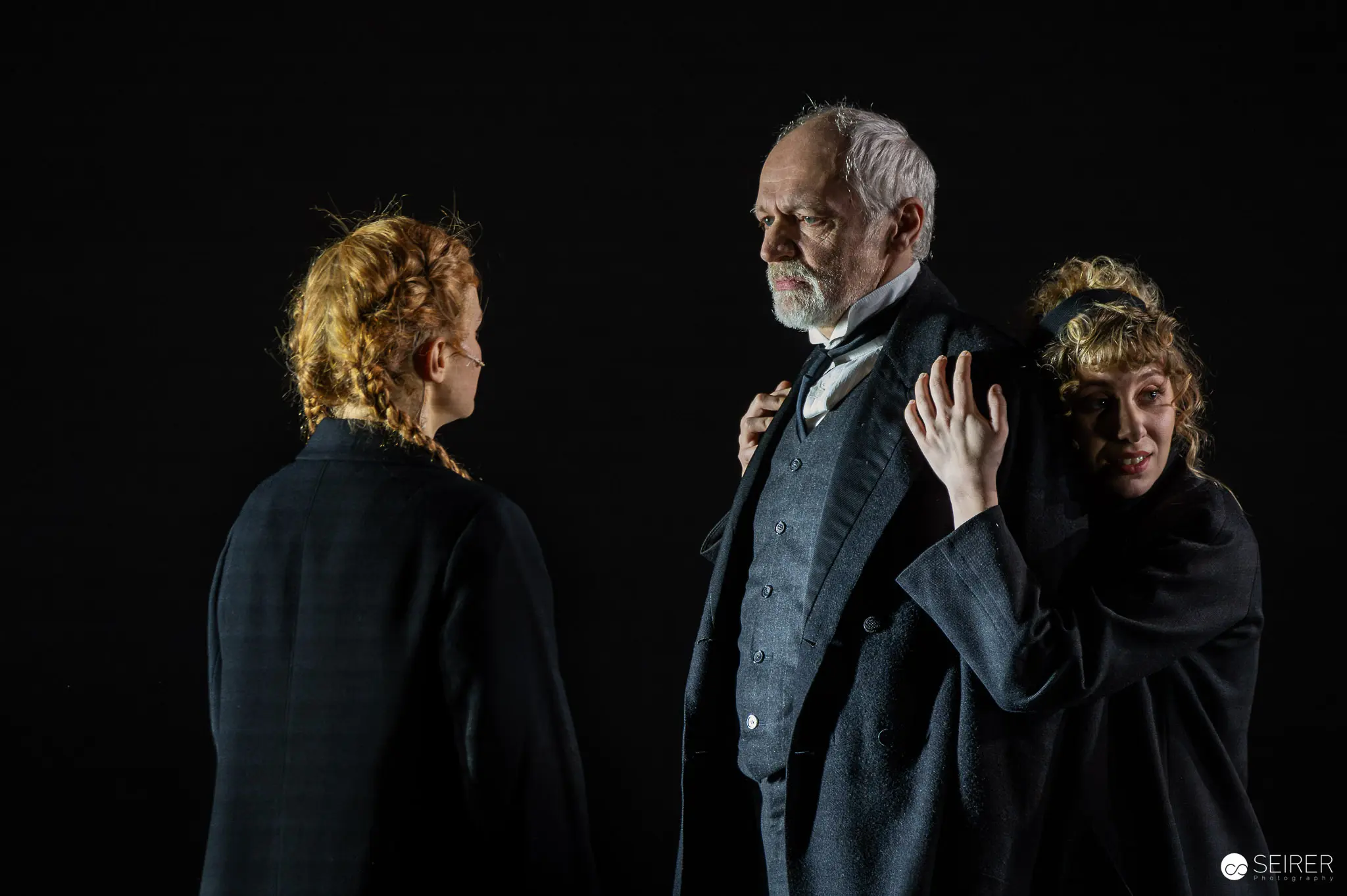 "Leben und Sterben in Wien" Theater in der Josefstadt, 2024 Three figures are positioned against a black backdrop in this production photograph from the Theater in der Josefstadt's 2024 premiere of Thomas Arzt's "Leben und Sterben in Wien." The central figure, dressed in a grey period vest and white shirt, stands between two women in dark costumes; one woman with braided hair faces him from the left while another peers from behind his shoulder on the right. The stark lighting emphasizes the period costuming and creates dramatic shadows, suggesting the tense interpersonal dynamics within this interwar Vienna drama directed by Herbert Föttinger. The theatrical composition and formal staging reflect the production's examination of political radicalization and social conflict during the Zwischenkriegszeit.
 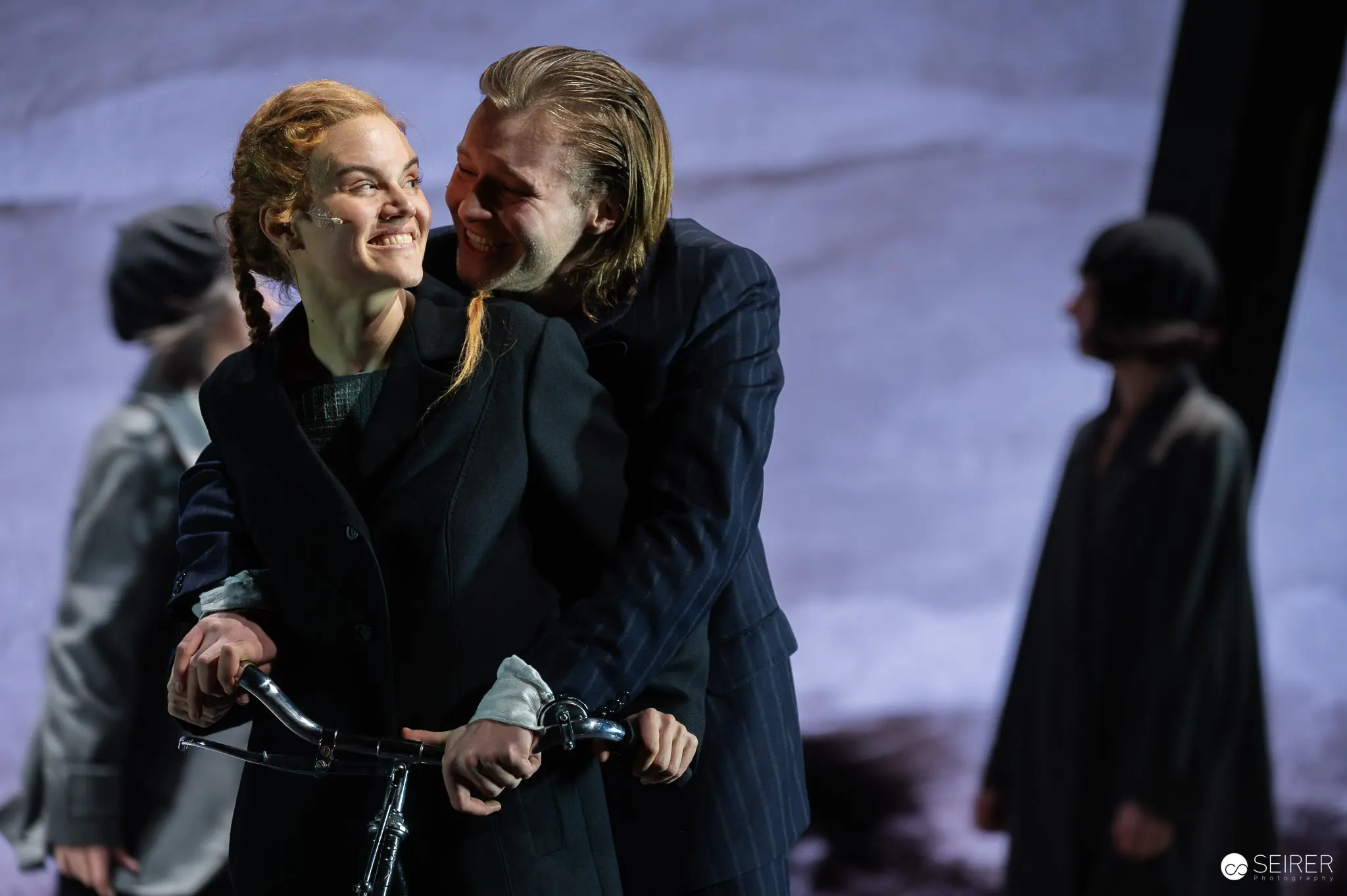 "Leben und Sterben in Wien" Theater in der Josefstadt, 2024 A male and female performer occupy the center of the frame against a backdrop suggesting an open, overcast sky, both dressed in dark period costumes consistent with 1920s-1930s Vienna. The woman, identified as Katharina Klar in the role of Fanni, stands at the handlebars of a bicycle while the man leans close from behind in an intimate gesture, his face near hers as both gaze toward stage right. The composition places the couple in sharp focus while additional ensemble members in period attire remain deliberately softened in the background, establishing spatial depth. This production photograph documents Herbert Föttinger's 2024 staging of Thomas Arzt's *Leben und Sterben in Wien* at Theater in der Josefstadt.
 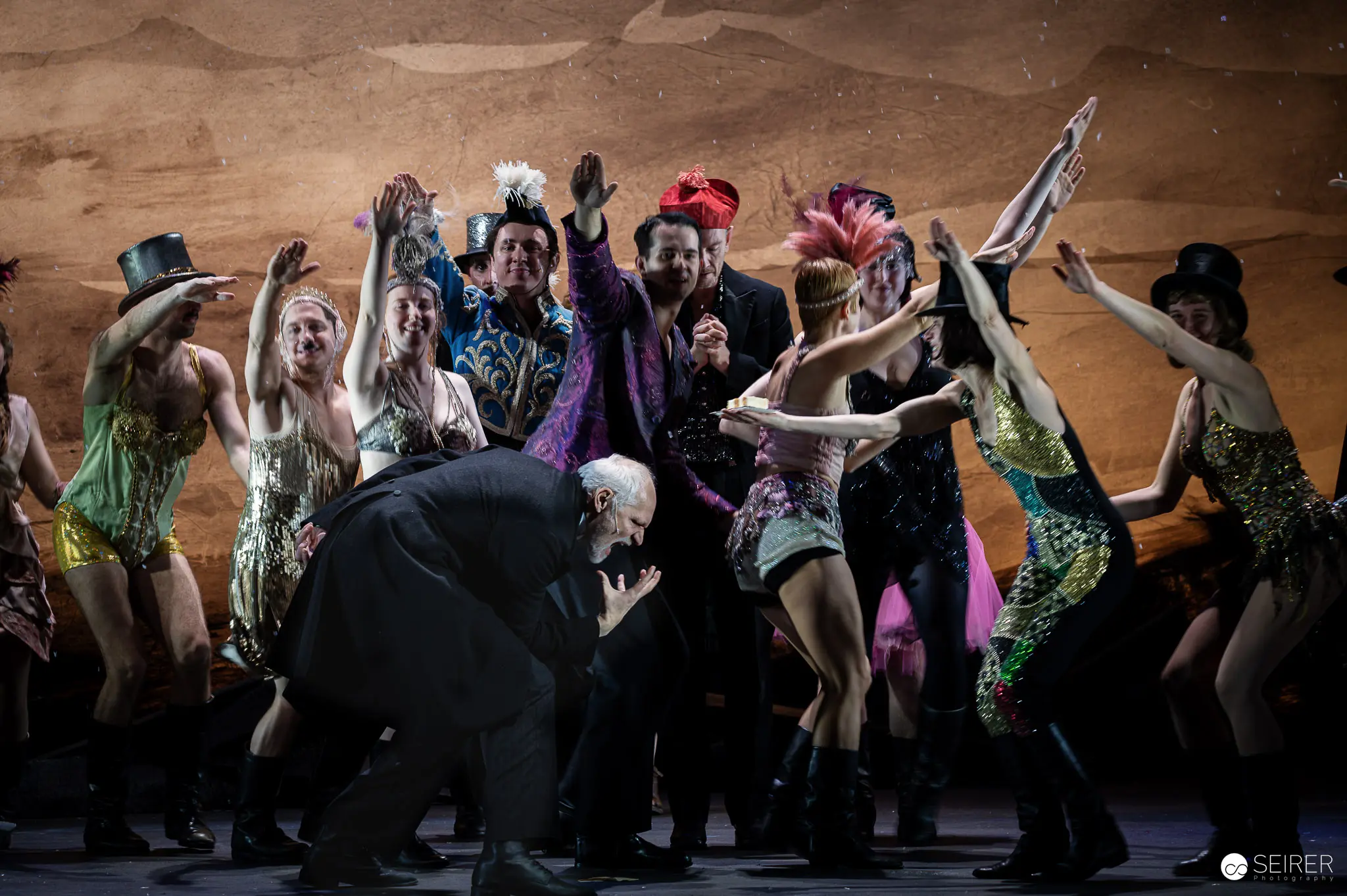 "Leben und Sterben in Wien" Theater in der Josefstadt, 2024 A theatrical ensemble scene from the Theater in der Josefstadt's 2024 production of "Leben und Sterben in Wien," depicting a cabaret-style chorus configuration against a painted backdrop suggesting urban architecture. The performers, arranged in a semicircular formation, wear costumes of contrasting styles—glittering showgirl attire in green and gold sequins juxtaposed with formal period dress and character headpieces—reflecting the social stratification of interwar Vienna. Central figures include ensemble members in theatrical poses with raised arms, while a suited figure bends forward among dancers, creating dynamic tension between high and low culture within Herbert Föttinger's directorial vision of Thomas Arzt's historical drama.
 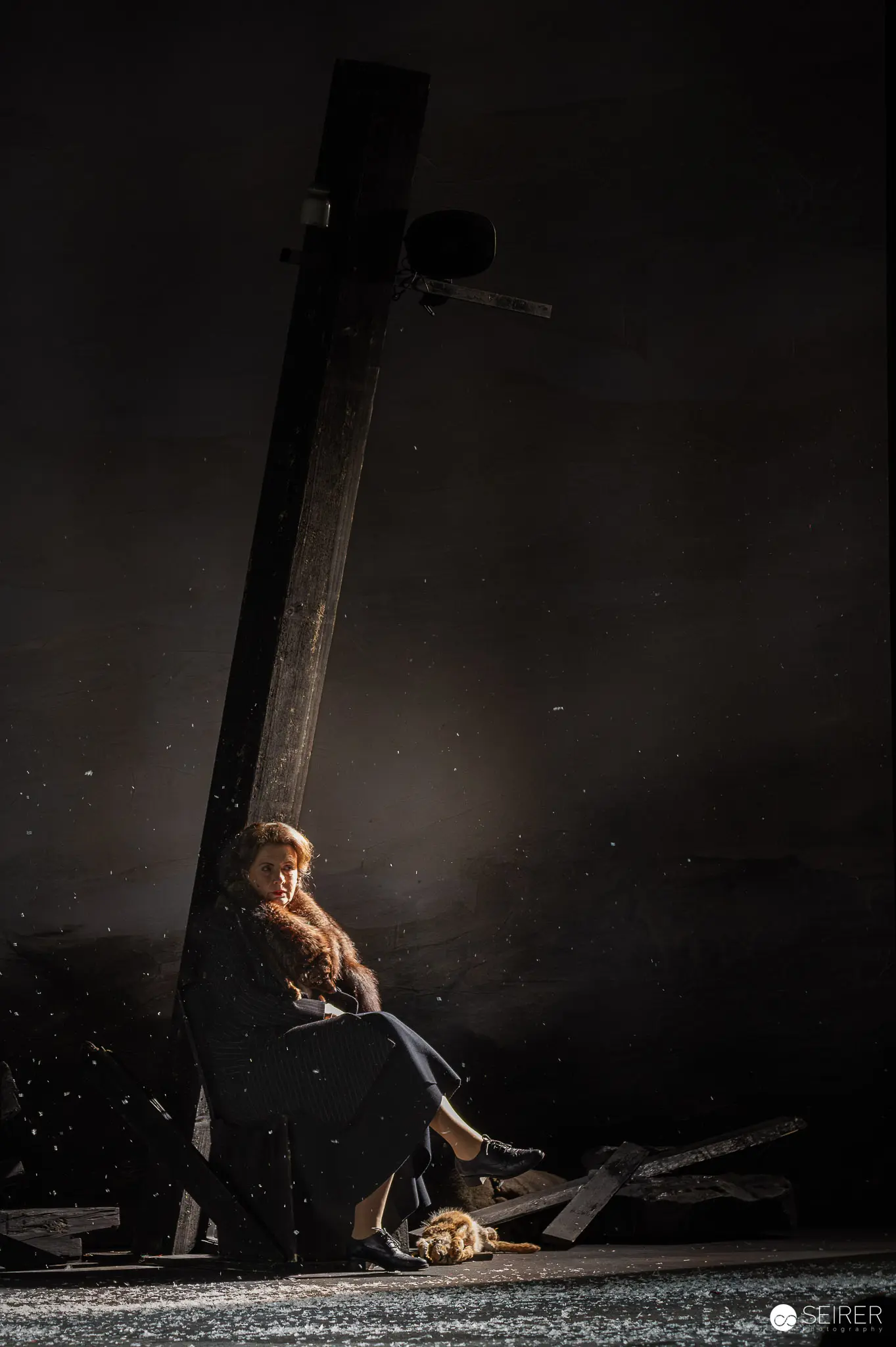 "Leben und Sterben in Wien" Theater in der Josefstadt, 2024 A solitary female figure sits at the base of a tall vertical structure, dramatically illuminated by a single light source from above in an otherwise darkened theatrical space. The concentrated beam creates a pronounced chiaroscuro effect, casting the actress in warm tones against deep shadows while particles of dust or atmospheric effects become visible in the light shaft. The composition emphasizes vertical monumentality through the pillar or post, which extends upward into darkness, while the seated woman's contemplative pose suggests isolation or introspection. This scene from Herbert Föttinger's 2024 production of "Leben und Sterben in Wien" at Theater in der Josefstadt features stage design by Die Schichtarbeiter, utilizing minimal scenic elements to evoke the interwar period setting.
 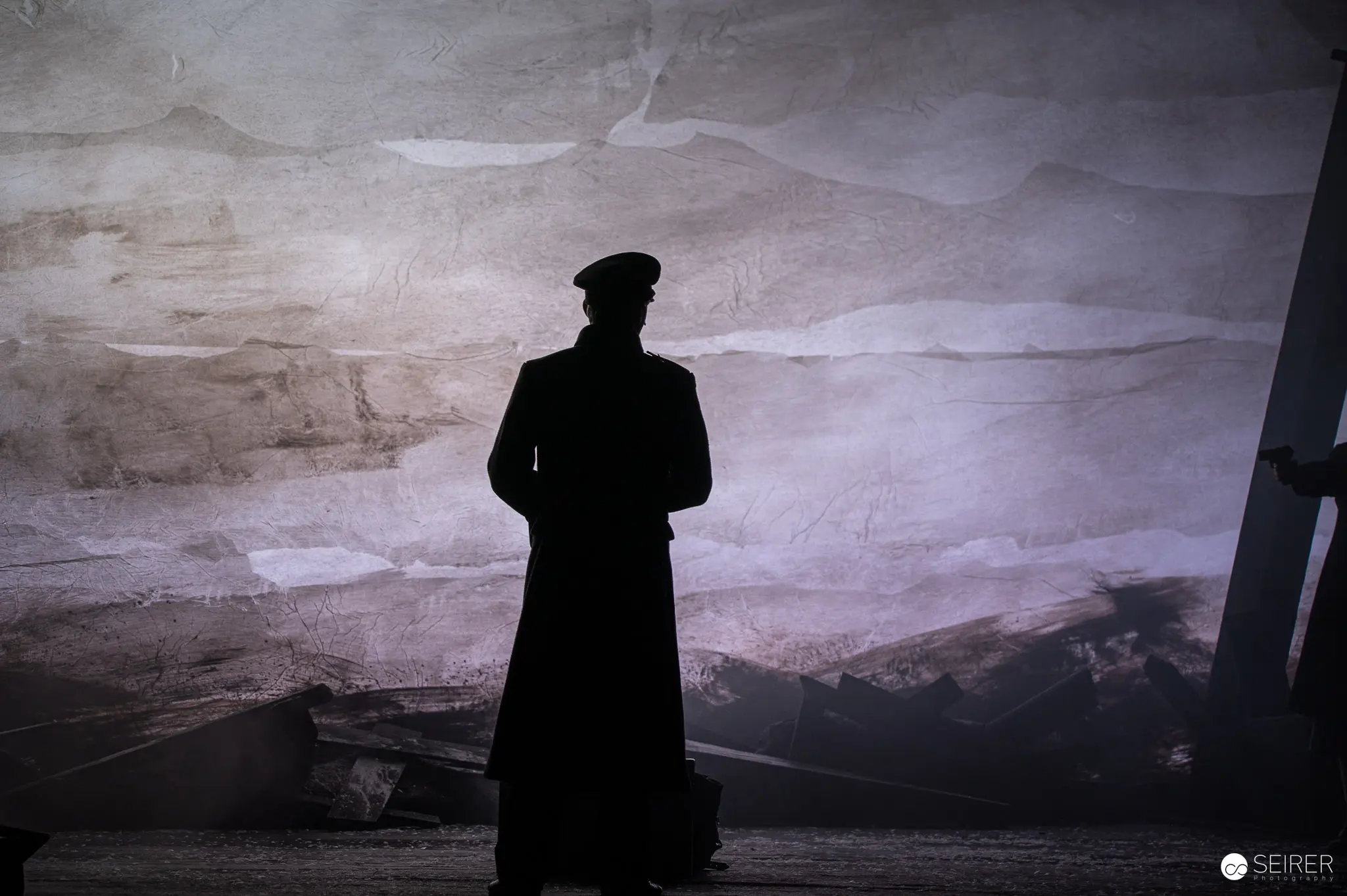 "Leben und Sterben in Wien" Theater in der Josefstadt, 2024 A silhouetted figure in military or official uniform, identifiable by the characteristic peaked cap and long coat, stands in contrapposto before a large-scale projected backdrop depicting a desolate, monochromatic landscape with geological striations. The theatrical lighting creates a stark chiaroscuro effect, reducing the performer to a dark cutout against the luminous scenographic surface designed by Die Schichtarbeiter for Herbert Föttinger's production. The compositional arrangement emphasizes the isolation of the individual against the vast, inhospitable terrain, visually reinforcing the interwar period's political tensions central to Thomas Arzt's *Leben und Sterben in Wien* at Theater in der Josefstadt.
 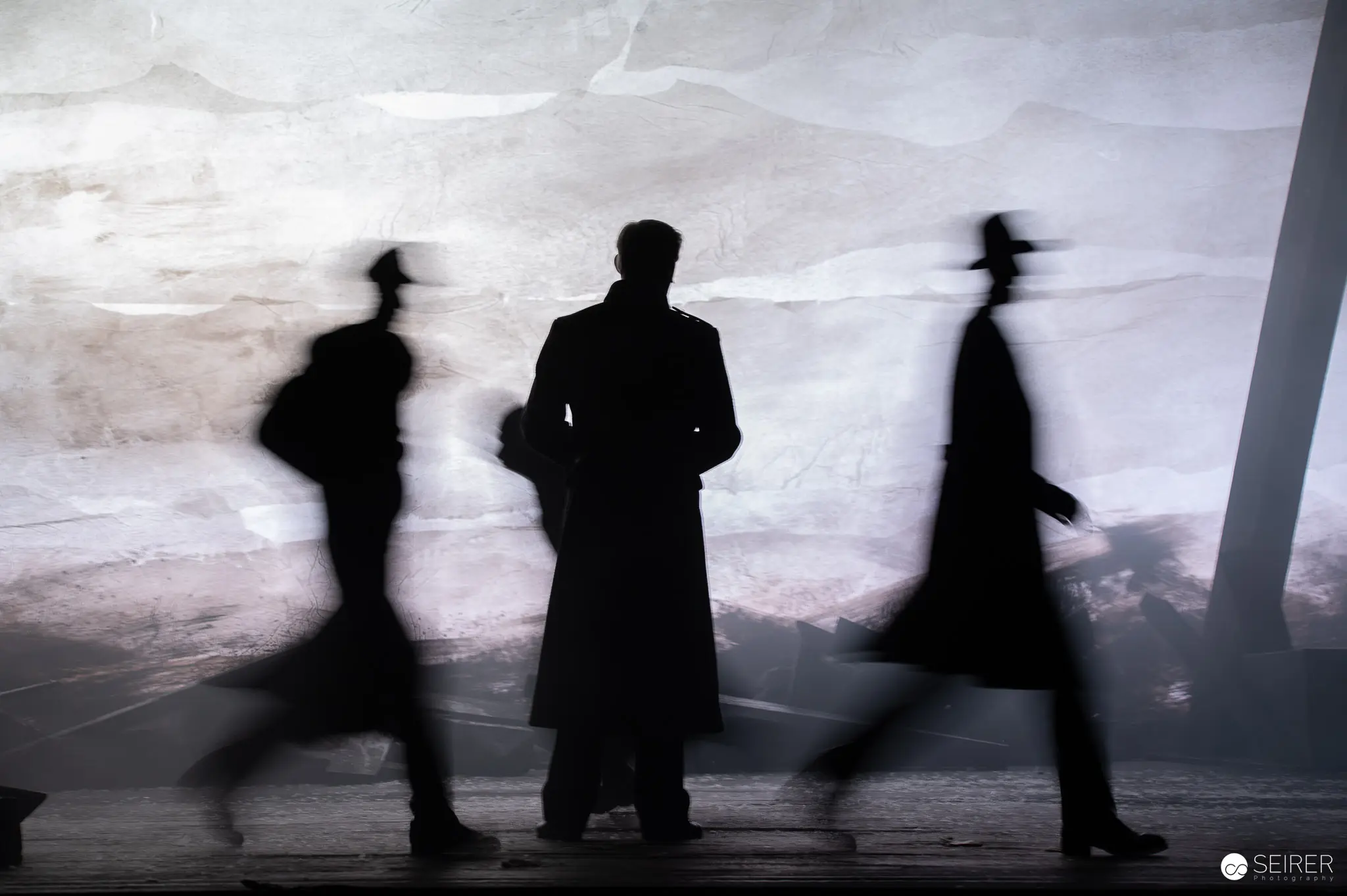 "Leben und Sterben in Wien" Theater in der Josefstadt, 2024 A solitary figure stands motionless in sharp silhouette at center frame, flanked by two figures in motion blur, creating a tripartite composition against a large-scale projected backdrop of misty, abstract landscape imagery. The central figure, distinguished by a long coat, maintains a static presence while the lateral figures—one seemingly carrying a bag on the left, one in motion on the right—dissolve into gestural streaks through extended exposure time. The stage floor reflects ambient light, contrasting with the ethereal, cloud-like projections that define the theatrical space. This scene from Thomas Arzt's *Leben und Sterben in Wien* at Theater in der Josefstadt employs theatrical lighting and projection design by Die Schichtarbeiter to evoke the temporal disorientation and social fragmentation of interwar Vienna.
 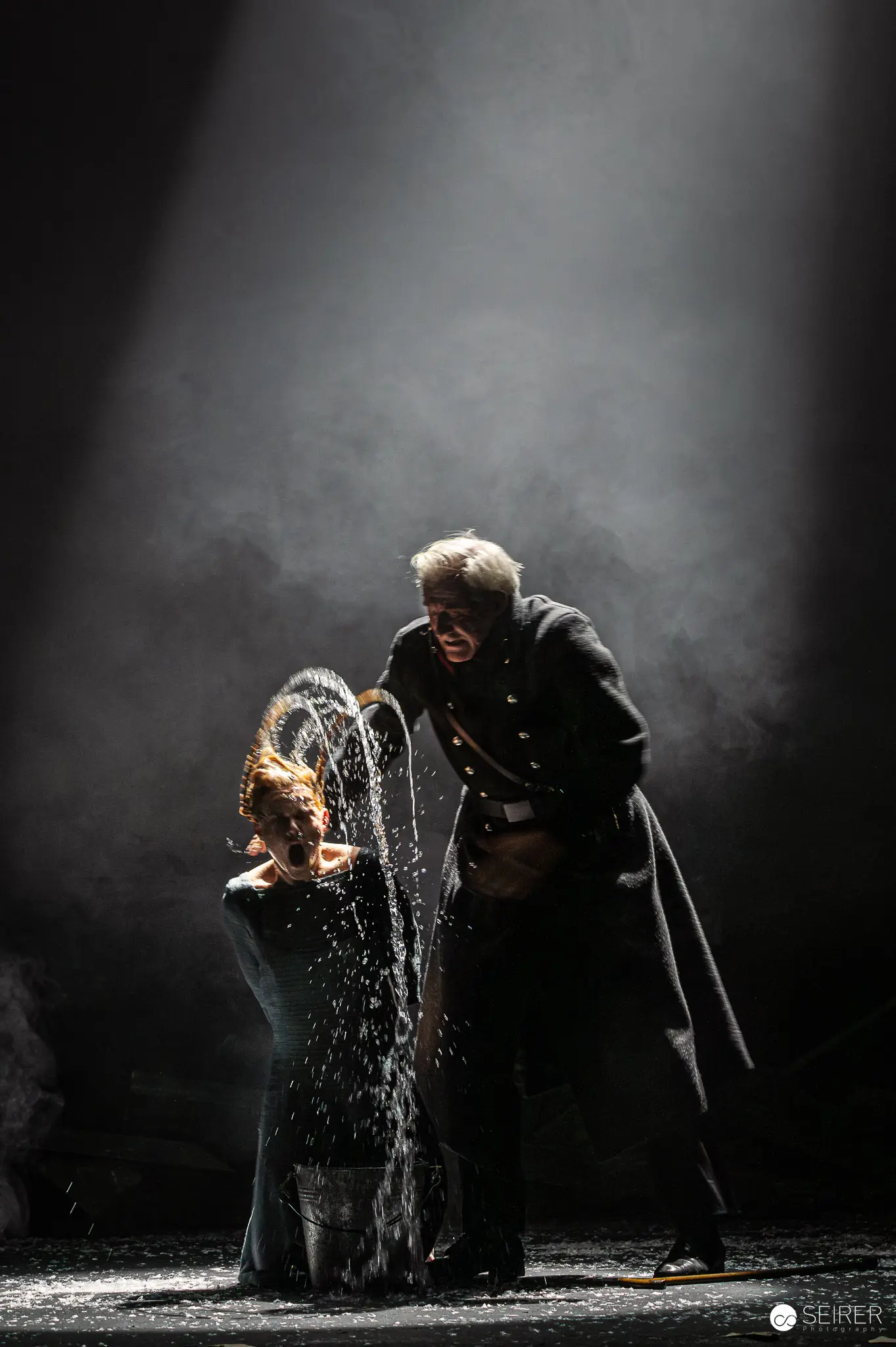 "Leben und Sterben in Wien" Theater in der Josefstadt, 2024 A dramatically lit scene shows two figures in stark chiaroscuro lighting against a dark background. One performer kneels while water cascades over them from above, their posture suggesting vulnerability or supplication, while a second figure in dark clothing stands over them in a position of authority or dominance. The theatrical moment, from Herbert Föttinger's staging of Thomas Arzt's *Leben und Sterben in Wien* at Theater in der Josefstadt, employs vertical light beams and the symbolic use of water to emphasize power dynamics central to the play's exploration of interwar Vienna's social tensions. Stage design by Die Schichtarbeiter creates a minimalist environment that focuses attention on the physical relationship between the characters.
  "Leben und Sterben in Wien" Theater in der Josefstadt, 2024 Portrait photograph showing an actress in three-quarter pose against a black background, wearing a deep red cardigan over a white and navy striped garment. The subject displays an animated, joyful expression with eyes closed and head tilted back, her curly blonde hair falling loosely around her shoulders. The dramatic chiaroscuro lighting creates strong tonal contrast, emphasizing the texture of the knitted outerwear and the spontaneity of the captured moment. This production photograph documents Katharina Klar, who portrayed the protagonist Fanni in Thomas Arzt's "Leben und Sterben in Wien" at Theater in der Josefstadt, 2024, directed by Herbert Föttinger.
 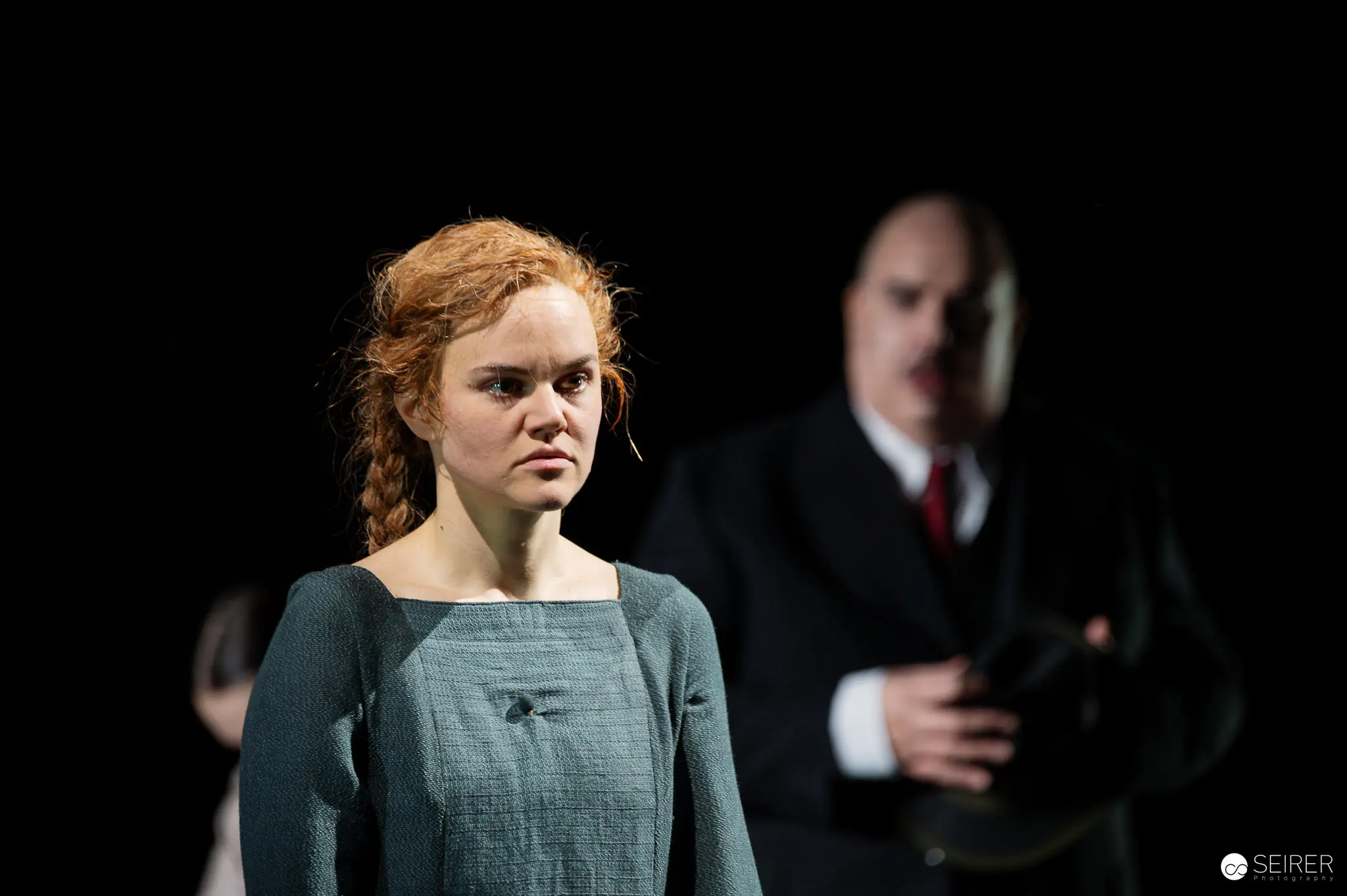 "Leben und Sterben in Wien" Theater in der Josefstadt, 2024 A female performer with auburn hair stands in sharp focus in the left foreground, wearing a gray-blue period dress with a small dark brooch, her expression solemn and direct. Behind her, deliberately out of focus, a male figure in dark formal attire with a red tie gestures with his hand, while another figure is visible deeper in the shadowed background. The theatrical lighting creates stark contrast against the black void, emphasizing the spatial separation between the focused protagonist and the blurred male presence, reinforcing themes of isolation and conflicting ideological forces in this Theater in der Josefstadt production of Thomas Arzt's interwar Vienna drama.
 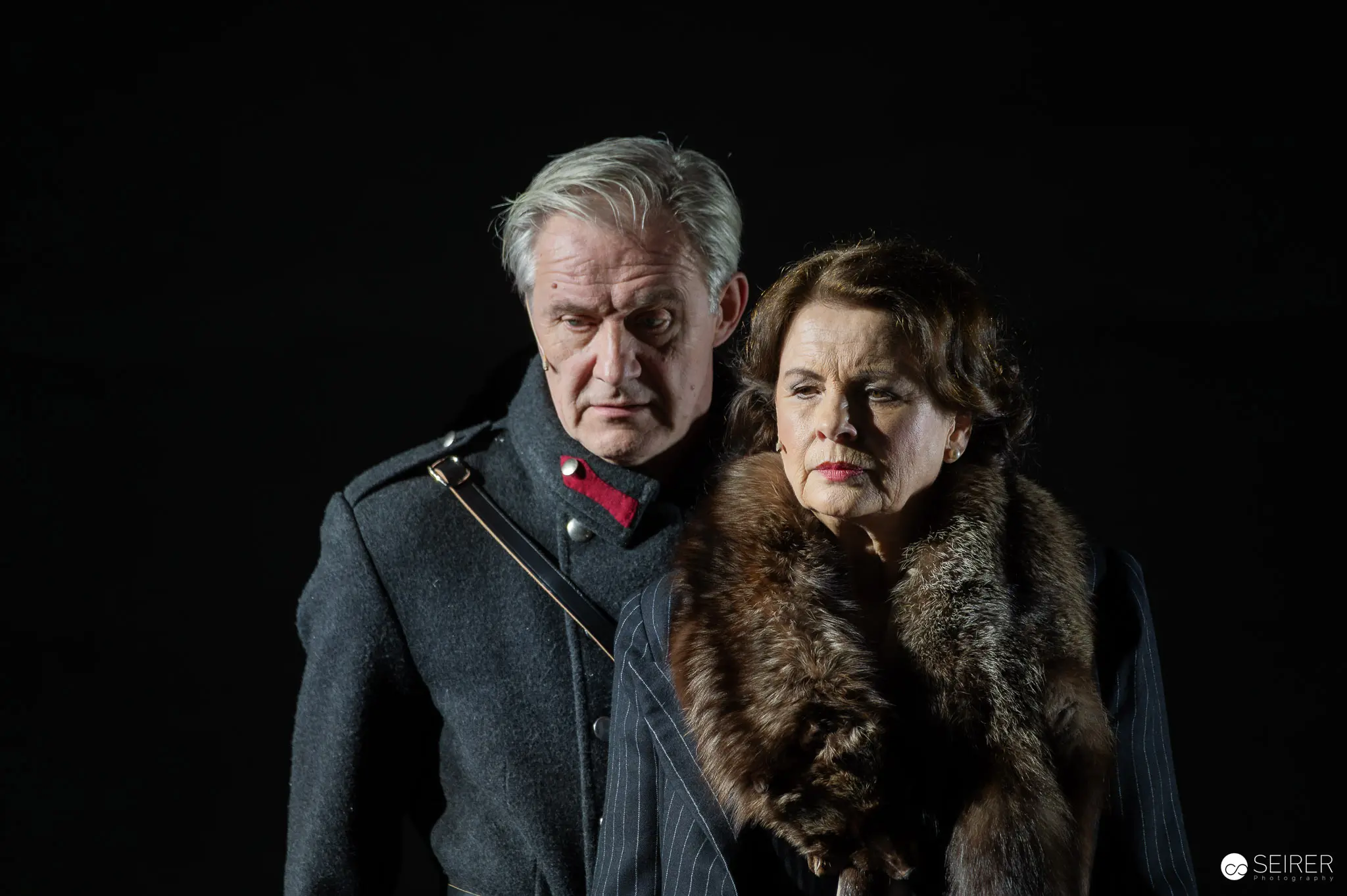 "Leben und Sterben in Wien" Theater in der Josefstadt, 2024 Two actors pose in three-quarter profile against a black backdrop, their figures sharply defined by directional stage lighting. The male figure, positioned slightly behind and to the left, wears a dark wool coat with pinstripe trousers and a red bow tie, his grey hair swept back; the female figure stands forward right, wrapped in a substantial fur stole over dark attire. Their solemn, forward-directed gazes and close proximity suggest an alliance or shared purpose, their period costumes evoking Vienna's interwar bourgeoisie. The portrait-style composition and dramatic chiaroscuro lighting emphasize characterization in this 2024 Theater in der Josefstadt production of Thomas Arzt's *Leben und Sterben in Wien*, directed by Herbert Föttinger.
 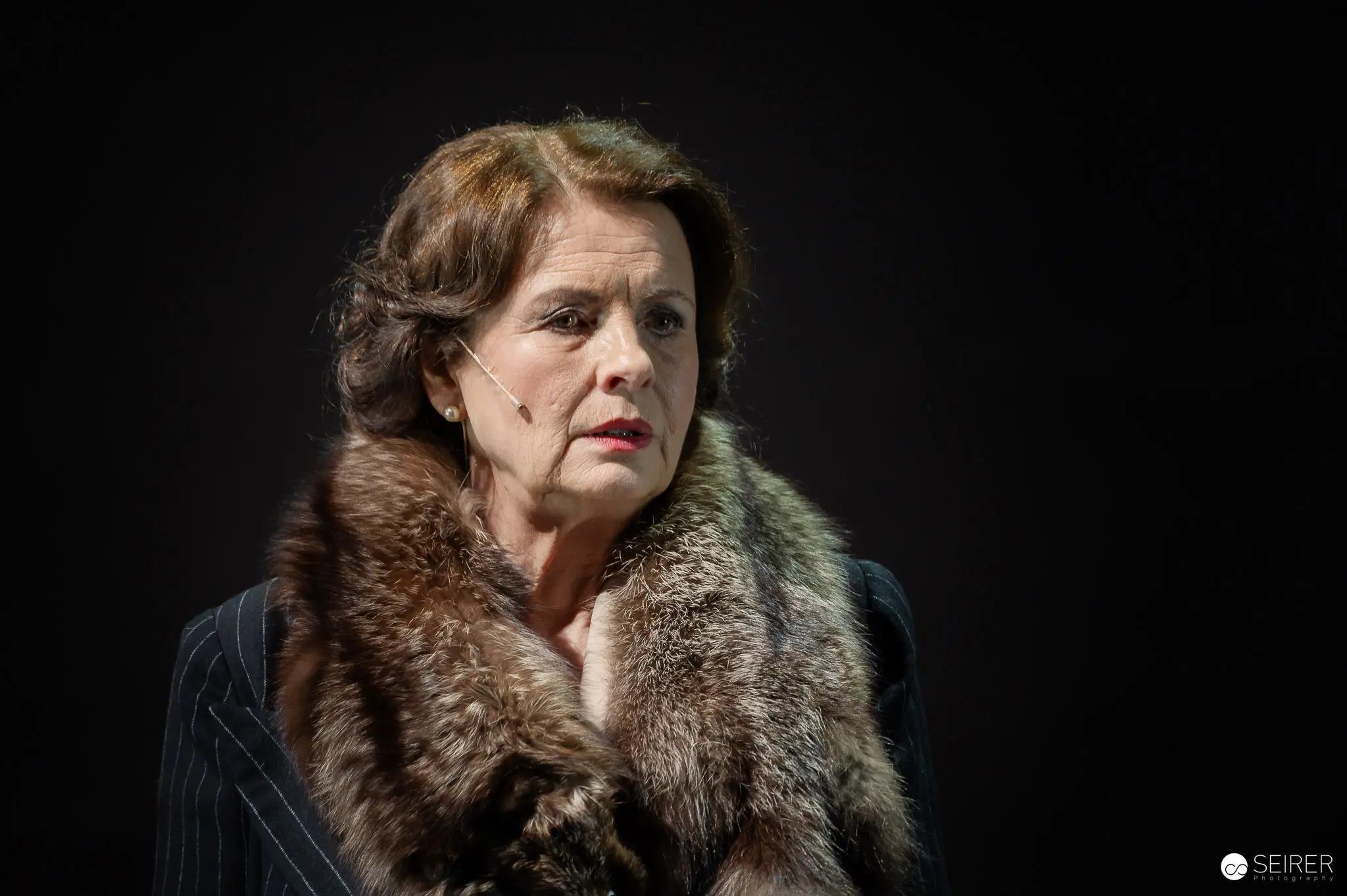 "Leben und Sterben in Wien" Theater in der Josefstadt, 2024 A female performer stands in three-quarter profile against a black background, wearing a dark pinstriped jacket with a prominent fur collar. The theatrical lighting creates strong contrasts, illuminating her face and the textured fur while the surrounding space recedes into darkness. Her expression is contemplative, her gaze directed off-camera, and her styled mid-length hair frames her face. The composition centers the figure within the frame, emphasizing the period costume details characteristic of the interwar Viennese setting. This production photograph documents *Leben und Sterben in Wien* by Thomas Arzt, directed by Herbert Föttinger with costumes by Birgit Hutter, performed at Theater in der Josefstadt in 2024.
 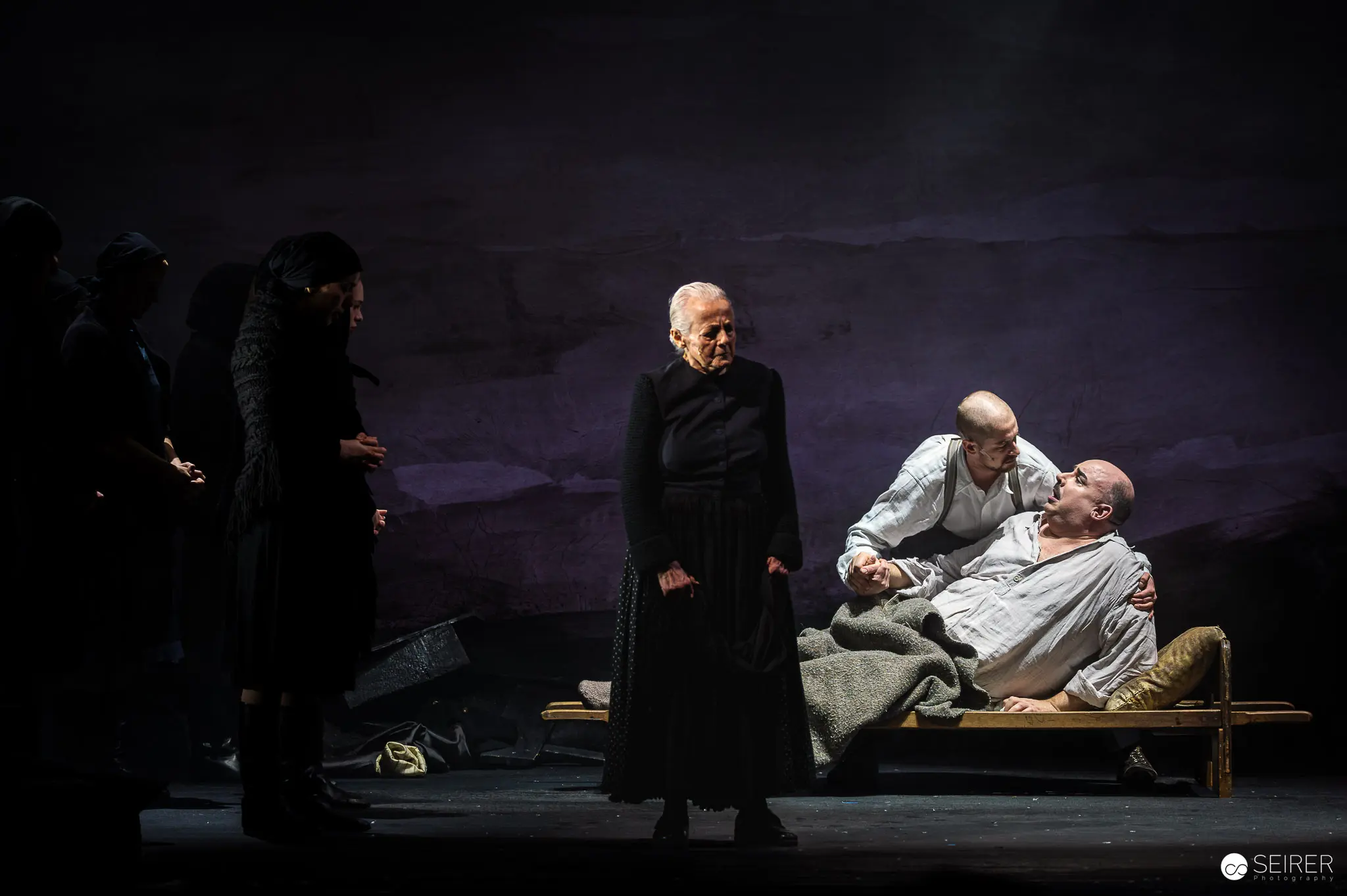 "Leben und Sterben in Wien" Theater in der Josefstadt, 2024 A somber tableau from Theater in der Josefstadt's 2024 production of "Leben und Sterben in Wien" depicts a deathbed scene against a darkly atmospheric backdrop. At center stage, a figure in black clerical robes—Robert Joseph Bartl as the Priest—stands in dignified stillness, while at right, a dying figure reclines on a simple wooden bench attended by another character in pale garments. Two figures in dark clothing observe from the left foreground, their forms partially silhouetted against the moody, deep blue-grey cyclorama. The stark lighting emphasizes the theatrical staging of mortality and spiritual attendance, reflecting the production's engagement with interwar Vienna's social and ideological conflicts. Direction by Herbert Föttinger, stage design by Die Schichtarbeiter.
 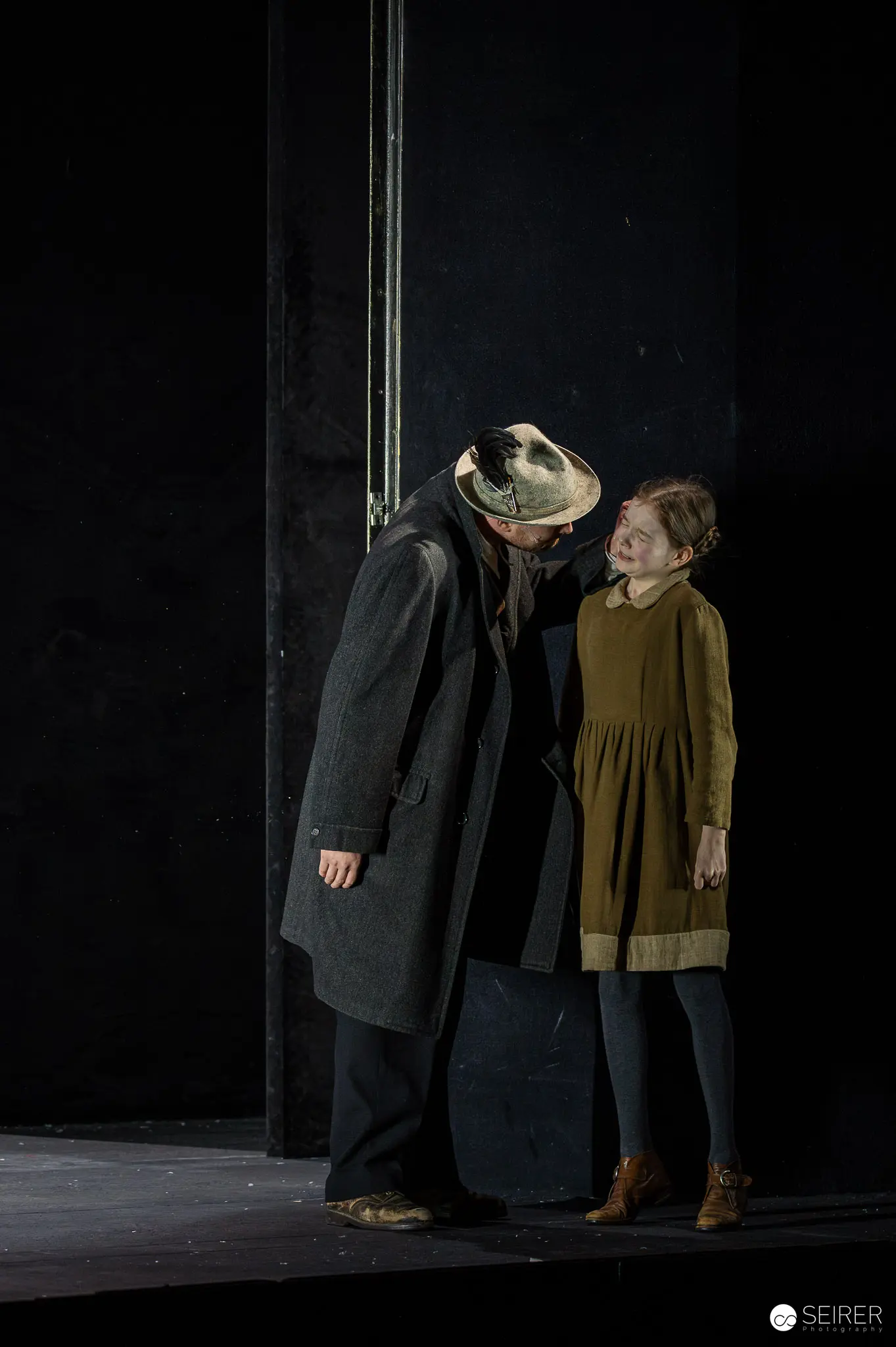 "Leben und Sterben in Wien" Theater in der Josefstadt, 2024 Two figures stand in stark contrast against a dark backdrop on stage: a tall figure in black clothing and a wide-brimmed hat tilts their head upward, while a shorter figure in a mustard-yellow period dress stands beside them, both spotlit against the darkness. The dramatic chiaroscuro lighting emphasizes the vertical line created by the metal pole or stage element behind them, establishing a stark compositional division. This scene from Herbert Föttinger's 2024 production of "Leben und Sterben in Wien" at Theater in der Josefstadt showcases the minimalist aesthetic created by Die Schichtarbeiter's scenic design, with costumes by Birgit Hutter defining the interwar Viennese period setting.
 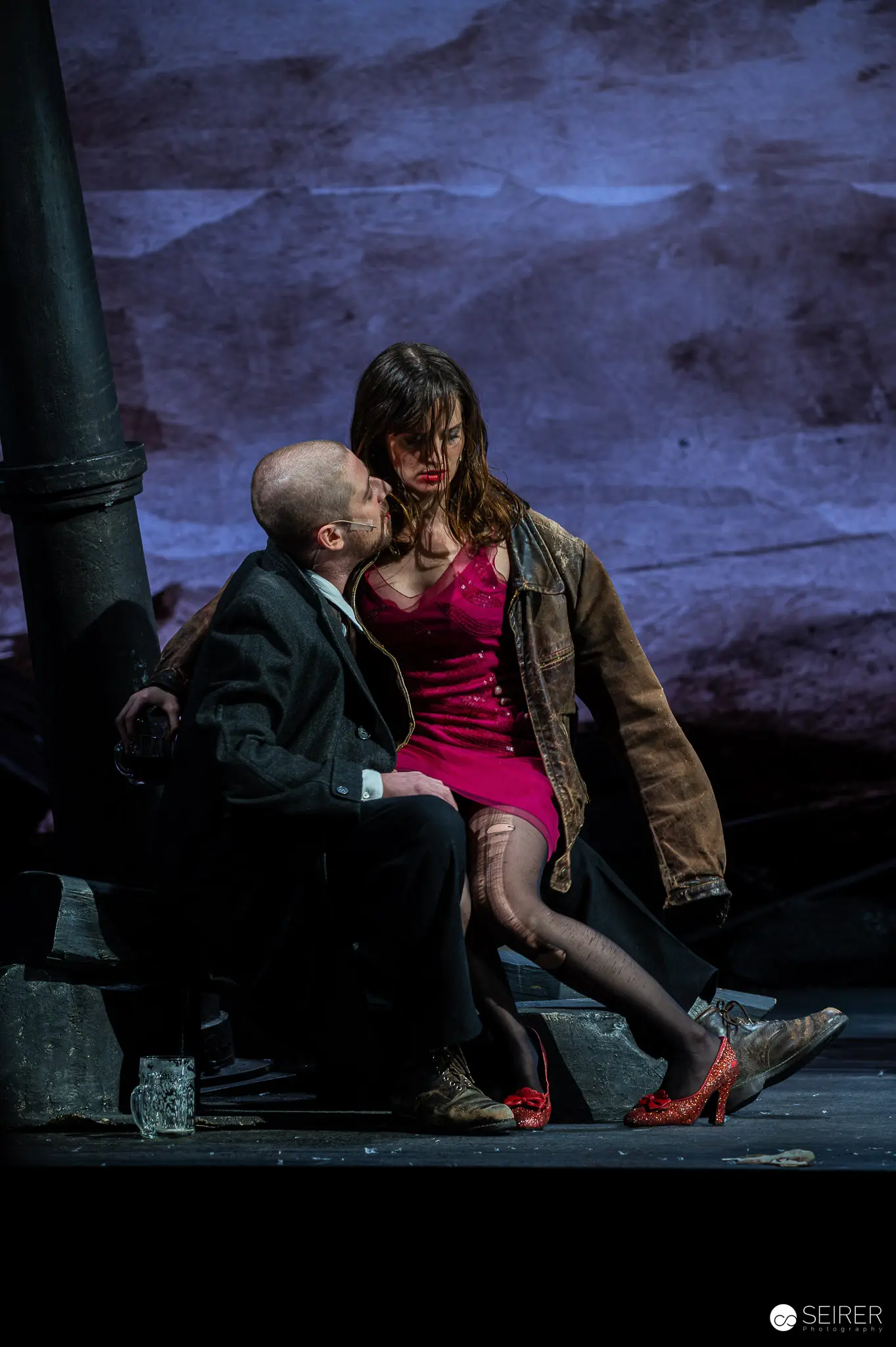 "Leben und Sterben in Wien" Theater in der Josefstadt, 2024 A three-figure ensemble occupies the forestage against a painterly backdrop suggesting an atmospheric landscape in muted blues and grays. At center, a woman in a crimson dress and black stockings is positioned between two men—one bald, wearing a dark suit to the left, and another in a brown jacket to the right—their proximity creating a triangular composition that emphasizes physical and dramatic tension. The theatrical lighting isolates the figures from the scenic environment, characteristic of Herbert Föttinger's direction in this 2024 Theater in der Josefstadt production of Thomas Arzt's *Leben und Sterben in Wien*, which explores political radicalization in interwar Vienna.
 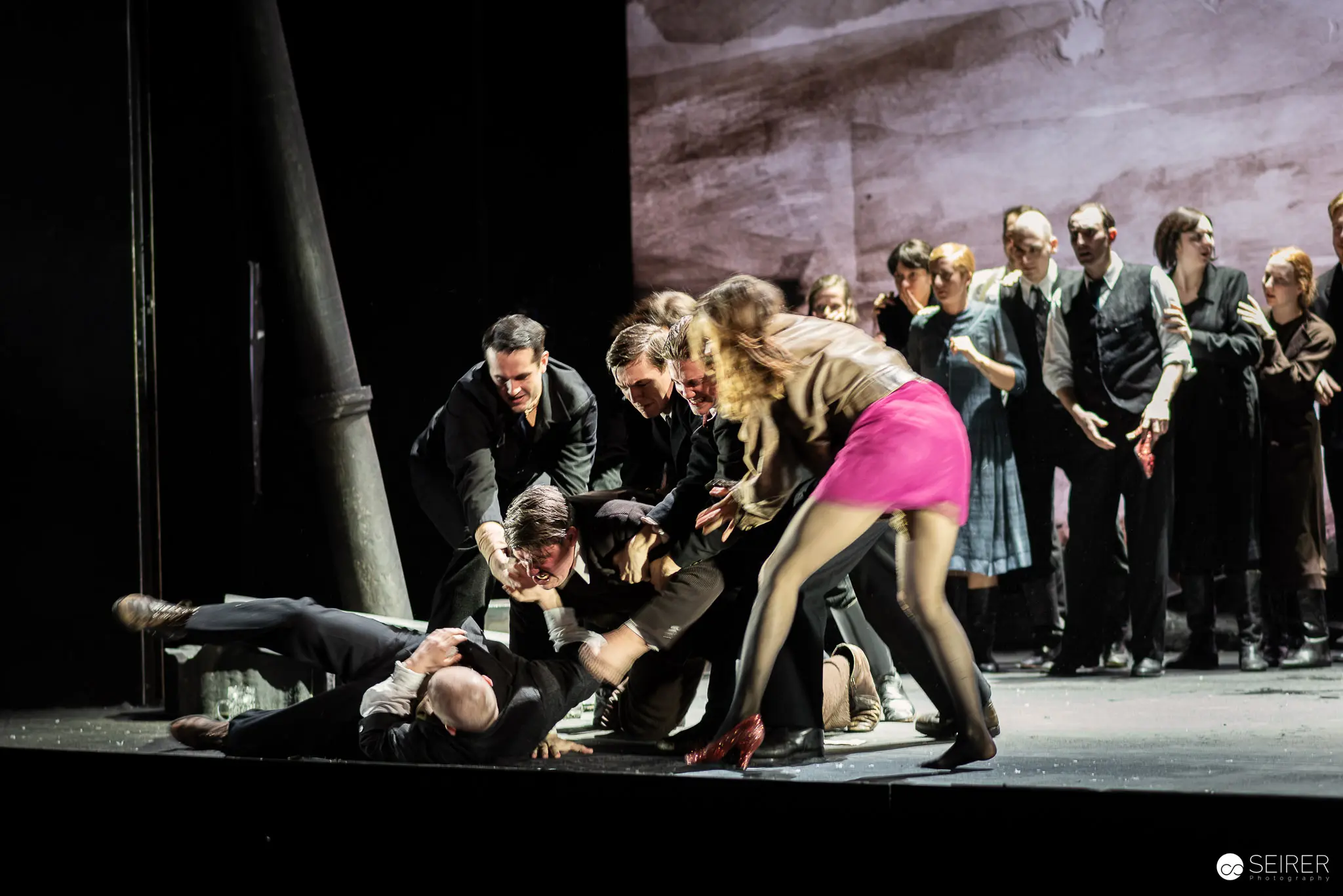 "Leben und Sterben in Wien" Theater in der Josefstadt, 2024 A dramatic moment from the Theater in der Josefstadt's 2024 production shows a central figure collapsed on the stage floor, surrounded by other performers in period costume attending to or observing the scene. The stage composition divides between the intimate cluster of actors in contemporary dress gathered around the prone figure and a line of ensemble members in darker clothing positioned upstage, with a projected backdrop depicting architectural stonework. The lighting isolates the central action in the foreground while maintaining visibility of the chorus behind, creating spatial depth characteristic of Herbert Föttinger's directorial approach to this interwar Vienna narrative. The pink-clad figure bent over the fallen person provides a vivid color accent against the predominantly dark palette of the ensemble's costumes.
 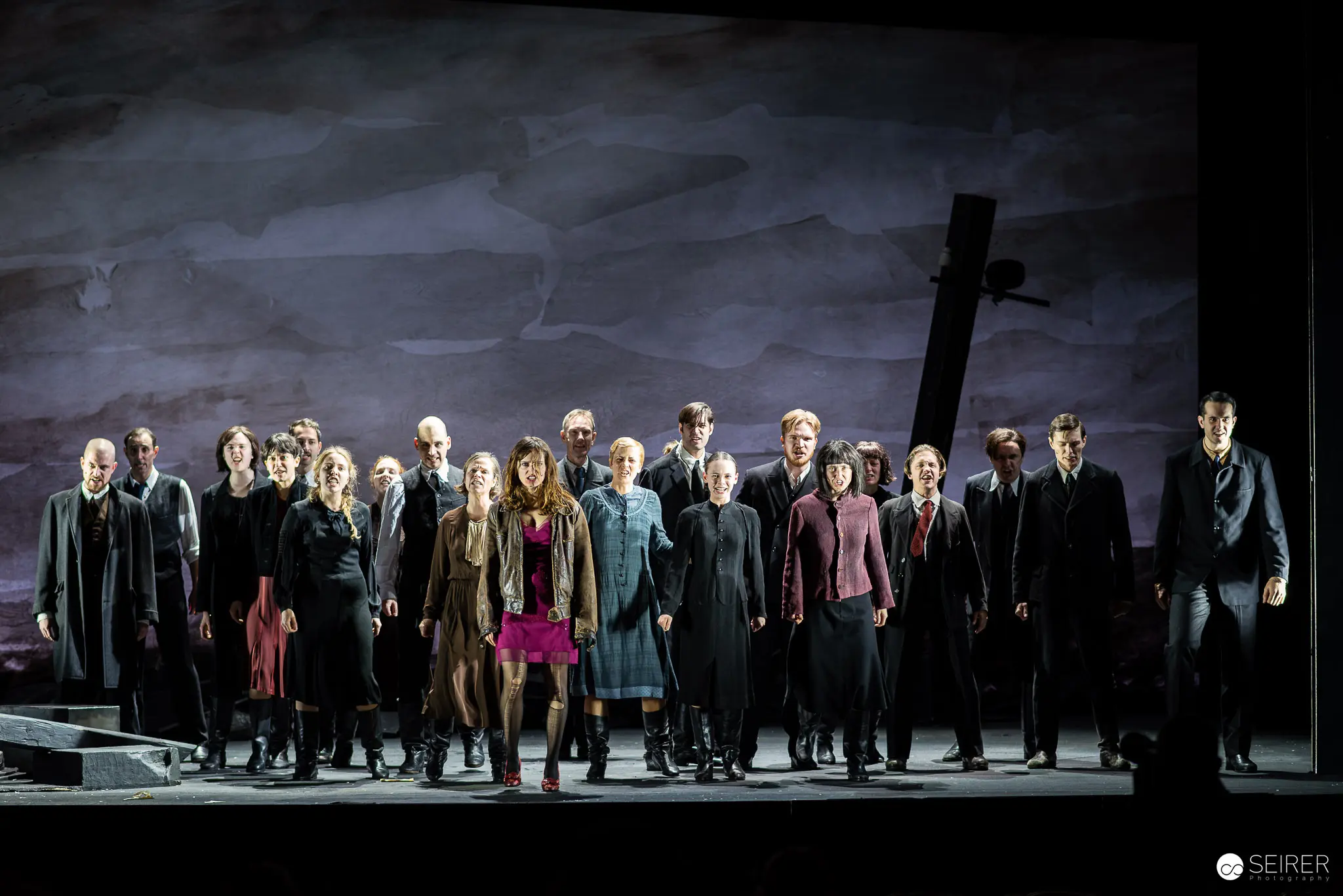 "Leben und Sterben in Wien" Theater in der Josefstadt, 2024 The ensemble stands arranged in a horizontal line across the stage against a backdrop of projected stormy skies and a stark silhouetted cross at right. The performers, predominantly dressed in dark period costumes with occasional accents of burgundy, blue, and pink, are positioned on an angular, multi-leveled platform that creates geometric shadows beneath them. The staging reflects Herbert Föttinger's direction and Die Schichtarbeiter's scenic design for Thomas Arzt's *Leben und Sterben in Wien* at Theater in der Josefstadt, with the full cast assembled in this tableau depicting the interwar tensions of 1920s-1930s Vienna.
 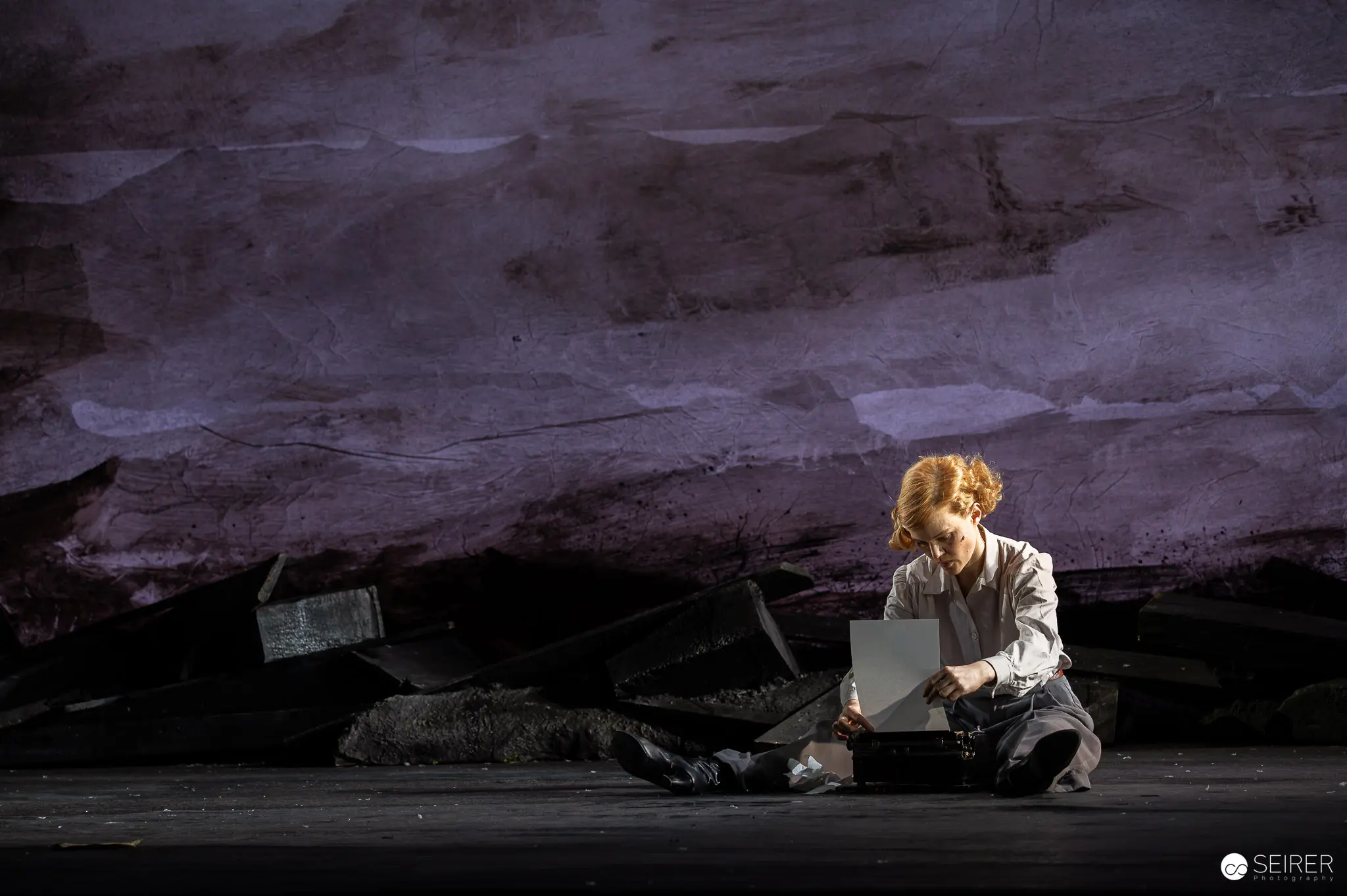 "Leben und Sterben in Wien" Theater in der Josefstadt, 2024 A solitary figure, identified as Jakob Elsenwenger in the role of Hans, sits in profile upon a darkened stage, hunched forward in contemplation while holding what appears to be papers or documents. The composition positions the actor against a vast projected backdrop depicting stratified rock formations or geological layers in muted grey and brown tones, creating a stark contrast between human scale and monumental natural imagery. Directional lighting illuminates the performer from stage left, casting him in relief against the expansive scenographic element designed by Die Schichtarbeiter for Herbert Föttinger's production at Theater in der Josefstadt. The staging emphasizes isolation and introspection within Thomas Arzt's historical drama set in interwar Vienna.
 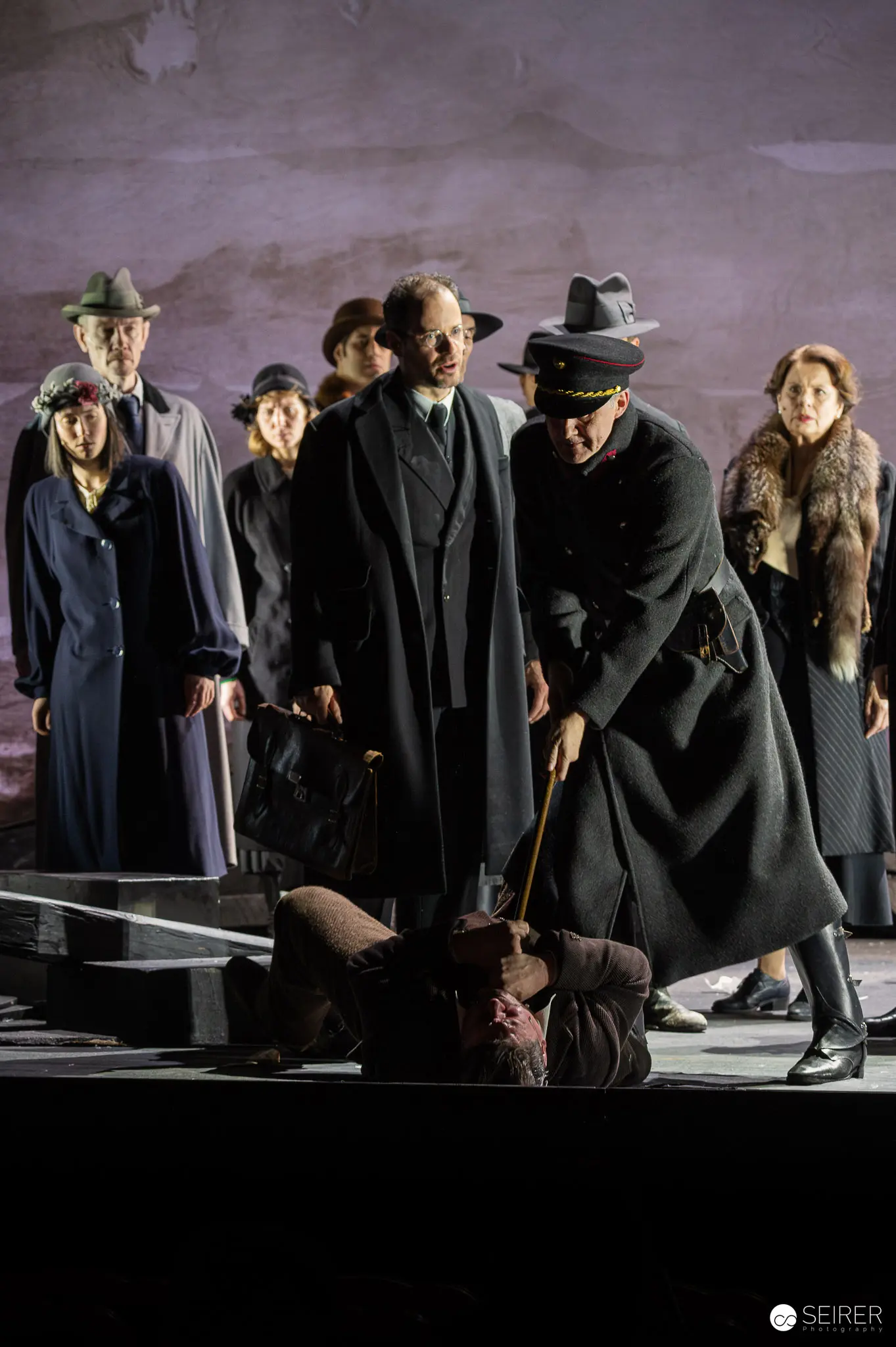 "Leben und Sterben in Wien" Theater in der Josefstadt, 2024 A group of seven performers in dark period coats and hats stands in a semicircle formation on stage, their attention directed toward a figure lying on the ground in the foreground. The scene employs stark theatrical lighting against a textured backdrop suggesting architectural walls, creating dramatic shadows and emphasizing the somber nature of the confrontation. The costuming reflects the interwar period setting of Thomas Arzt's *Leben und Sterben in Wien*, with the ensemble's positioning and unified gaze toward the prone figure suggesting a moment of collective judgment or witness in this production directed by Herbert Föttinger at Theater in der Josefstadt.
 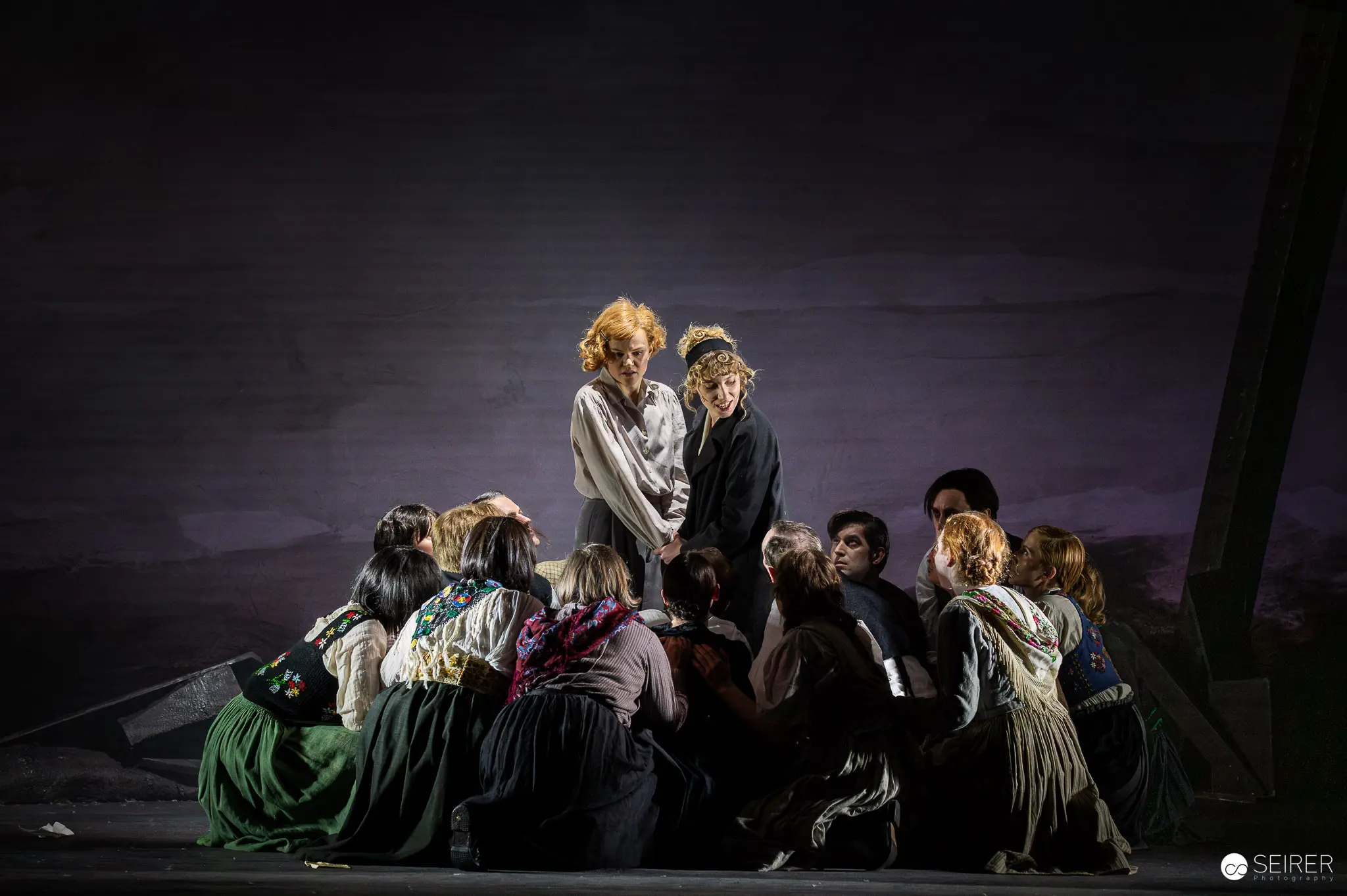 "Leben und Sterben in Wien" Theater in der Josefstadt, 2024 A central female figure in light-colored draping stands elevated above a clustered group of seated and kneeling performers dressed in period costumes of the interwar era, including long skirts, shawls, and dark garments. The composition radiates from this focal point against a gradient backdrop shifting from deep purple to charcoal, with dramatic overhead lighting isolating the figures within the darkness. The spatial arrangement creates a hierarchical tableau suggesting a moment of communal gathering or instruction, characteristic of the ensemble scenes in Thomas Arzt's "Leben und Sterben in Wien" at Theater in der Josefstadt, directed by Herbert Föttinger with scenic design by Die Schichtarbeiter.
 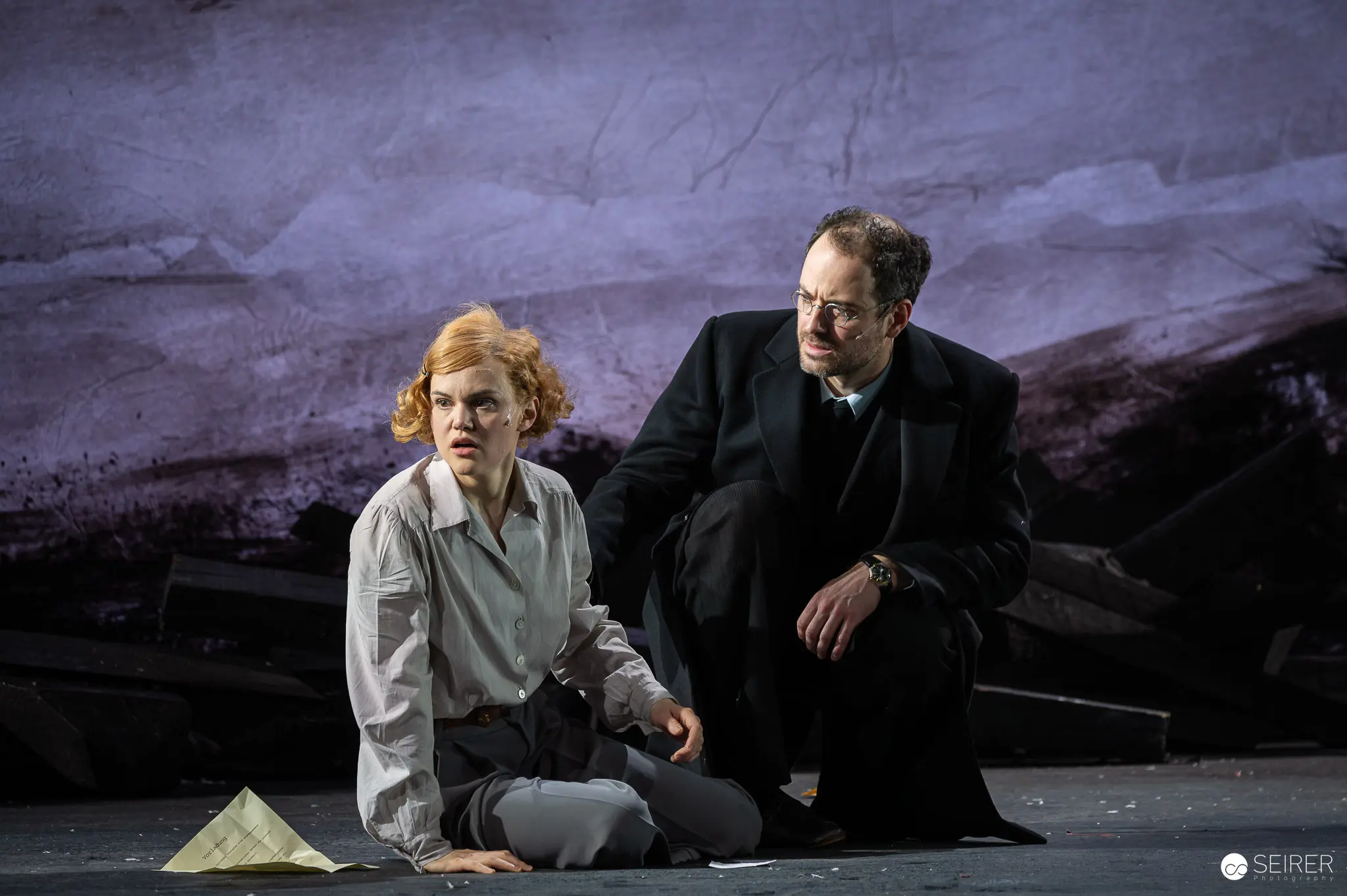 "Leben und Sterben in Wien" Theater in der Josefstadt, 2024 A staged scene from the 2024 Theater in der Josefstadt production shows Katharina Klar as Fanni seated on the stage floor beside Robert Joseph Bartl portraying the Priest, both positioned against a backdrop depicting a monochromatic winter landscape. The composition places the figures in the lower right quadrant, with Fanni in worker's attire—pale shirt and trousers—gazing outward while the black-clad priest leans toward her in a gesture suggesting counsel or confession. The theatrical lighting creates a somber atmosphere consistent with Herbert Föttinger's staging of Thomas Arzt's interwar Vienna drama, with scenic design by Die Schichtarbeiter establishing the period's austere social conditions.
 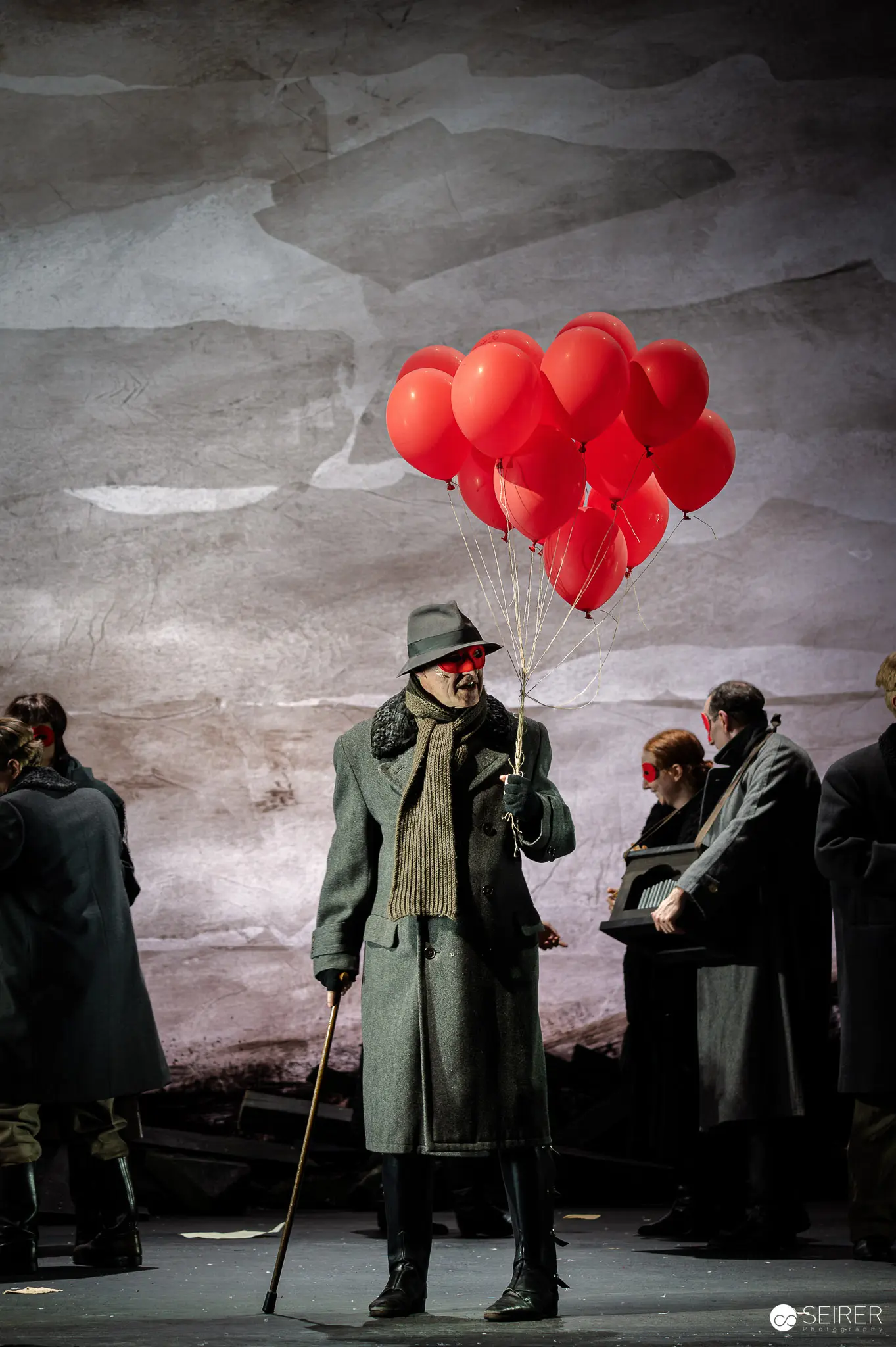 "Leben und Sterben in Wien" Theater in der Josefstadt, 2024 A male figure in a long gray coat, dark hat, and scarf stands center stage holding a cluster of vibrant red heart-shaped balloons and a walking stick, while other performers in dark overcoats occupy the wings. The scene unfolds against a projected backdrop of dramatic, painterly clouds rendered in monochromatic tones, creating stark chromatic contrast with the saturated red balloons. This moment from Herbert Föttinger's 2024 production of "Leben und Sterben in Wien" at Theater in der Josefstadt employs selective colorization against grayscale scenography, emphasizing symbolic elements within Thomas Arzt's historical drama set in interwar Vienna, with scenic design by Die Schichtarbeiter and costumes by Birgit Hutter.
 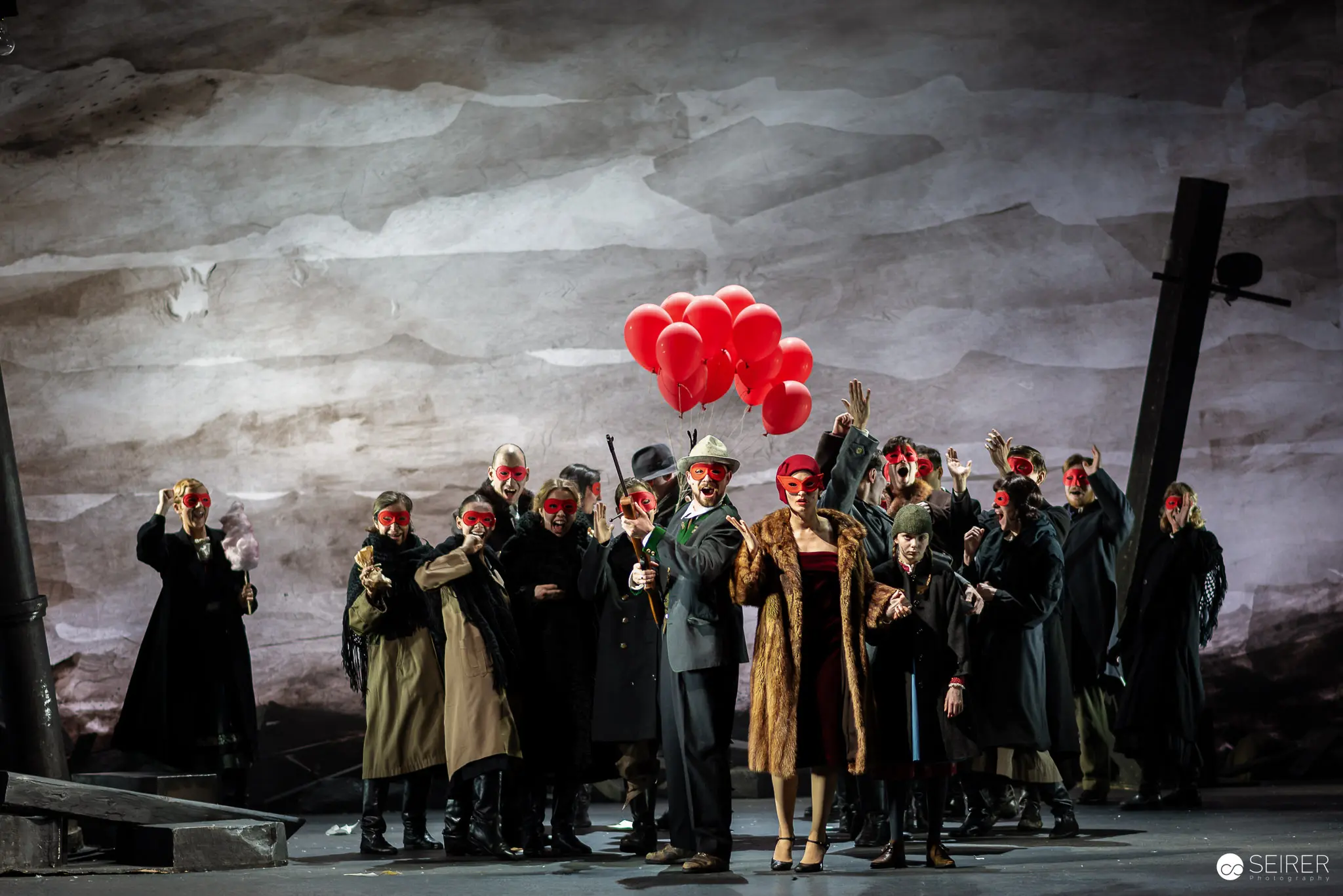 "Leben und Sterben in Wien" Theater in der Josefstadt, 2024 The ensemble of performers stands clustered at center stage, each wearing distinctive red headwear that creates a striking visual motif against the muted, painterly backdrop suggesting stormy skies. A figure in tan holds a cluster of red balloons that echoes the crimson caps, while the group's varied period costumes—ranging from dark coats to lighter dresses—reflect the interwar Viennese social spectrum central to Thomas Arzt's historical drama. The staged composition, lit with theatrical precision, positions the actors in a tight formation that suggests both collective solidarity and individual vulnerability, characteristic of Herbert Föttinger's direction at Theater in der Josefstadt. The painted backdrop's gestural brushstrokes and the vertical post at right frame the human assembly within an expressionistic theatrical space.
 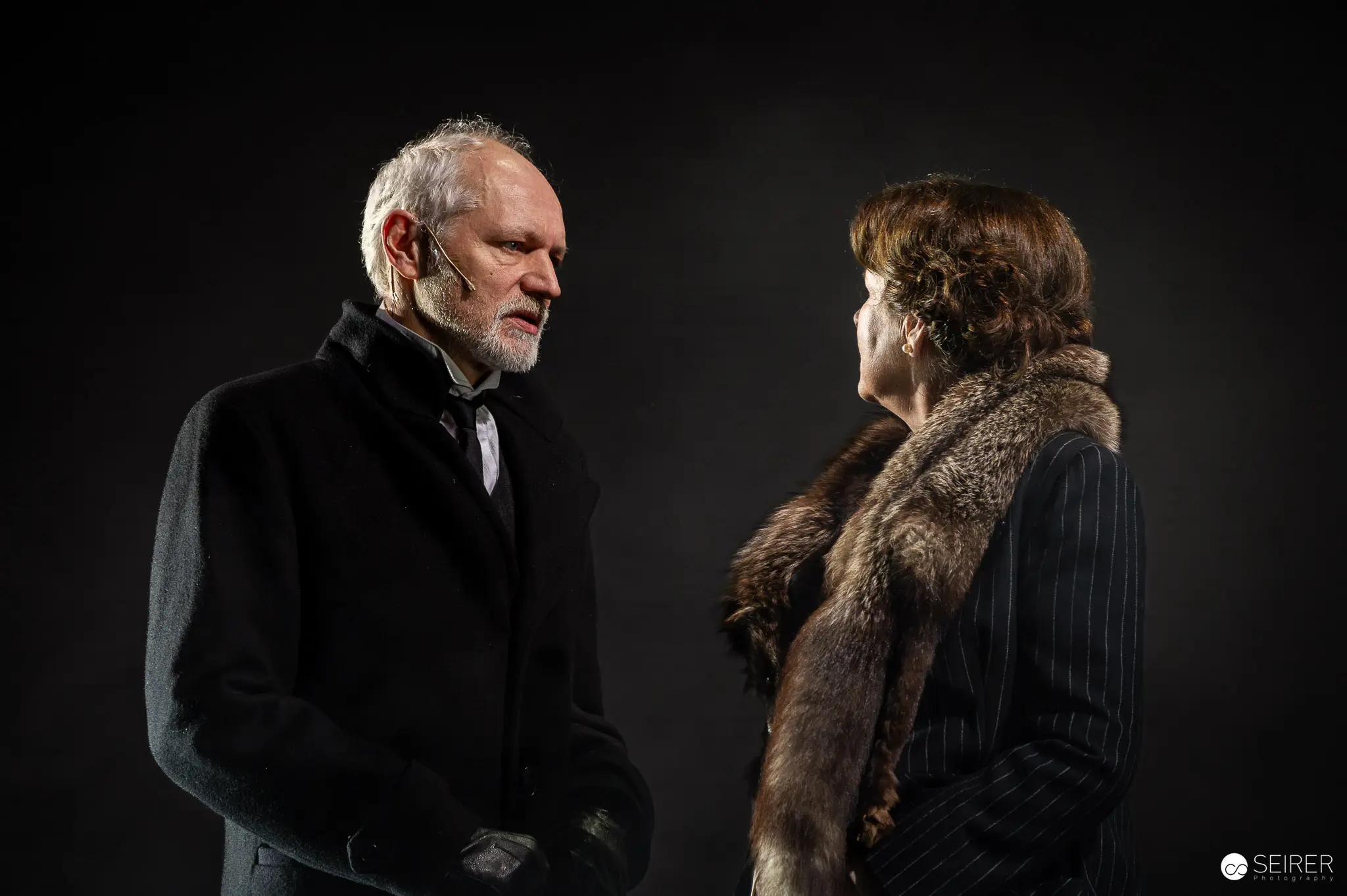 "Leben und Sterben in Wien" Theater in der Josefstadt, 2024 Two figures in period costume engage in direct confrontation against a black backdrop, their profiles illuminated by dramatic side lighting. The elder male figure at left, dressed in dark formal attire with a black coat, faces a younger figure in pinstriped clothing with fur collar trim. The stark chiaroscuro lighting emphasizes the tension between the characters while the theatrical staging isolates them in an undefined space characteristic of the production's minimalist aesthetic at Theater in der Josefstadt. This moment from Thomas Arzt's "Leben und Sterben in Wien" (2024), directed by Herbert Föttinger, exemplifies the interpersonal conflicts that mirror the broader ideological struggles of interwar Vienna depicted throughout the performance.
 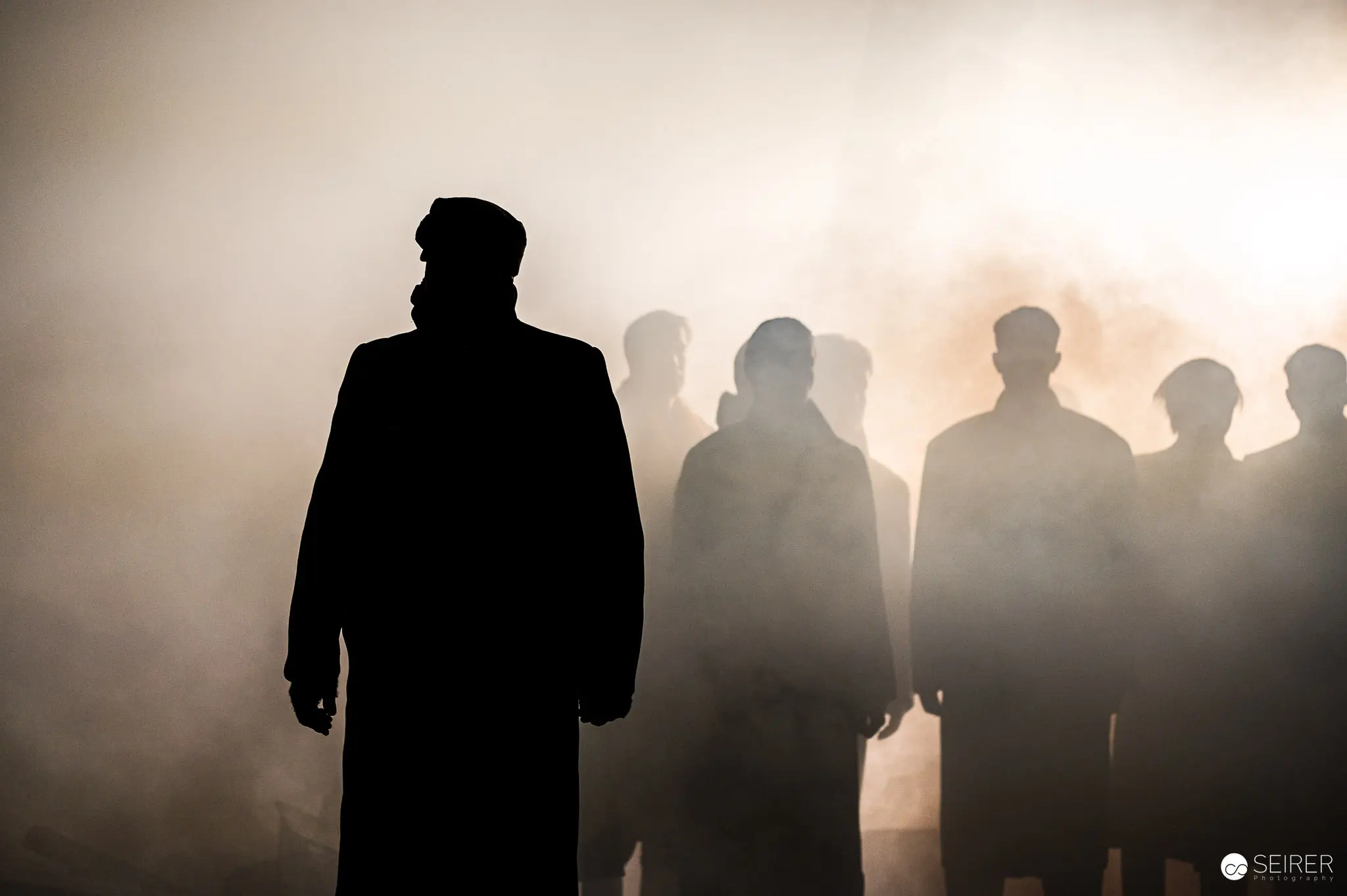 "Leben und Sterben in Wien" Theater in der Josefstadt, 2024 A solitary figure in silhouette stands in the foreground, isolated from a group of five figures visible through atmospheric haze in the background. The lighting creates a dramatic chiaroscuro effect, with warm, diffused illumination emanating from behind the crowd, while the foreground figure remains completely darkened. This staging technique, part of the scenic design by Die Schichtarbeiter for Herbert Föttinger's production at Theater in der Josefstadt, visually reinforces the thematic separation between individual and collective within Thomas Arzt's interwar Vienna drama. The composition employs theatrical fog and strategic backlighting to create distinct spatial planes, emphasizing psychological and political isolation within the narrative framework.
 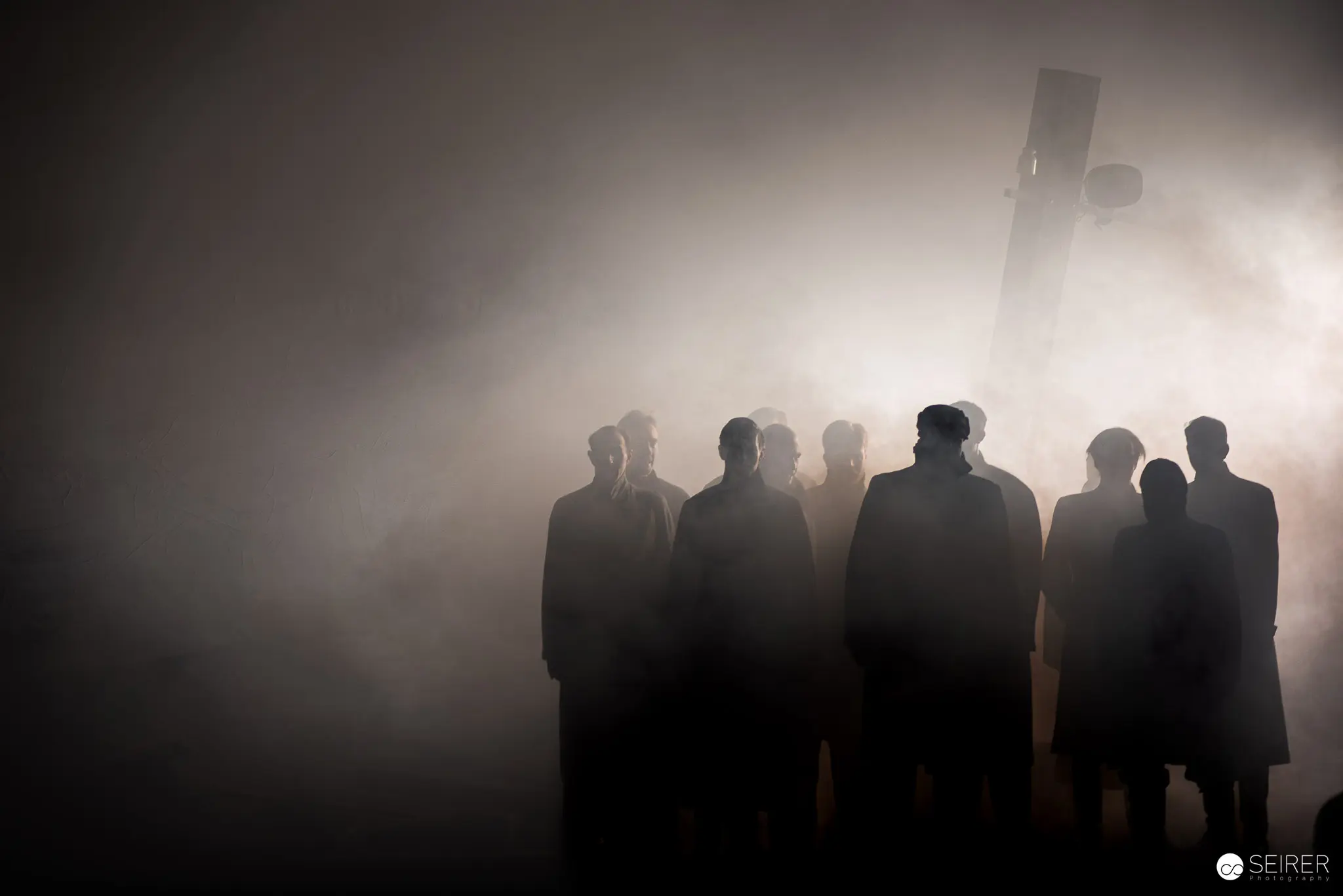 "Leben und Sterben in Wien" Theater in der Josefstadt, 2024 A group of seven figures stands in silhouette against an intensely backlit, fog-filled stage, creating a dramatic chiaroscuro effect characteristic of expressionist theatrical design. The performers, dressed in dark coats suggestive of 1920s-30s period costume, are arranged in a horizontal formation with varying degrees of spacing, their bodies rendered as near-black forms against the luminous atmospheric haze. Above and behind them, a vertical structural element—likely scaffolding or set architecture by Die Schichtarbeiter—emerges from the mist, reinforcing the industrial aesthetic of this 2024 production of *Leben und Sterben in Wien* at Theater in der Josefstadt, directed by Herbert Föttinger. The composition evokes the political tensions and ideological confrontations central to Thomas Arzt's interwar Vienna narrative.
 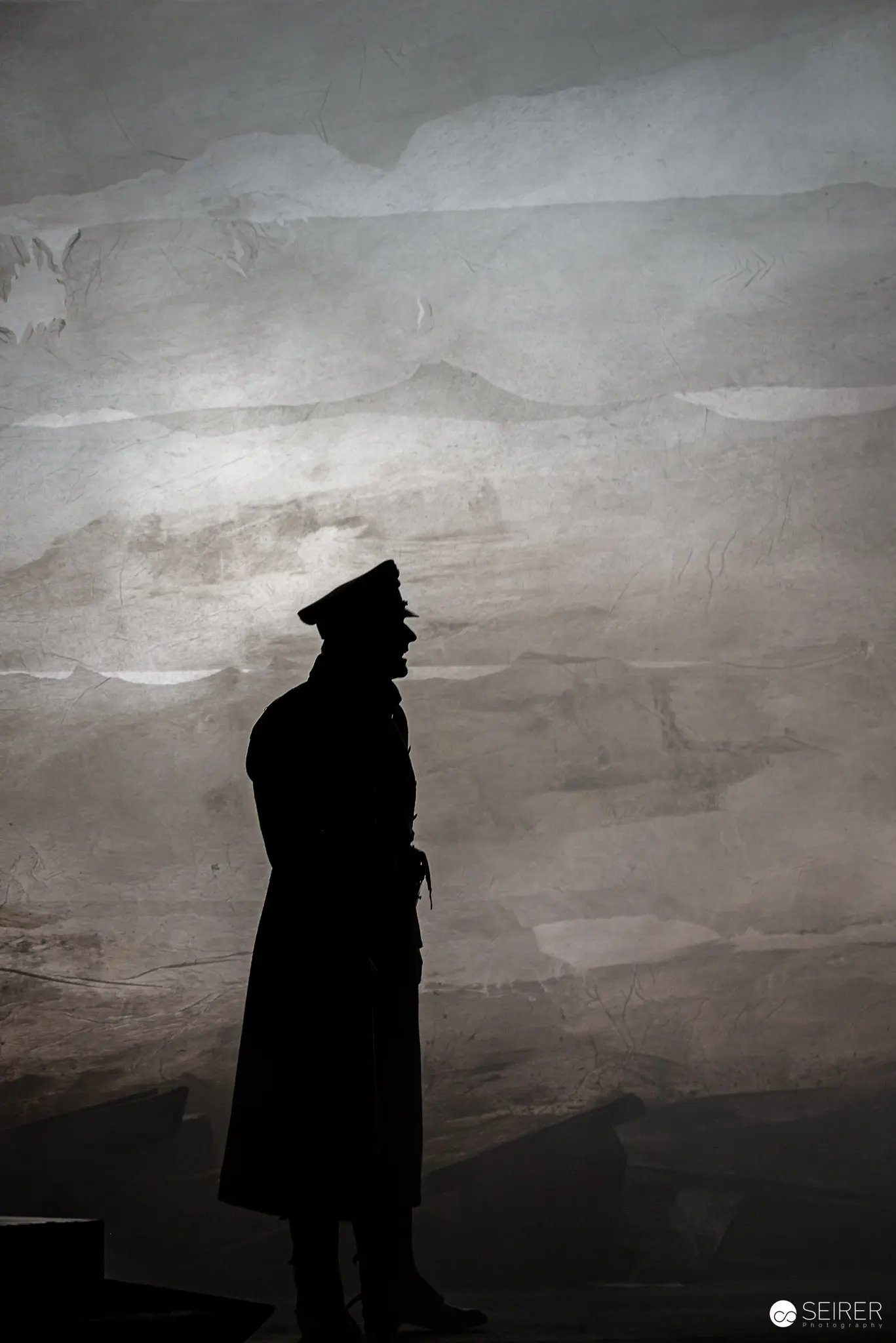 "Leben und Sterben in Wien" Theater in der Josefstadt, 2024 A silhouetted figure in military uniform and cap stands in profile against a textured, atmospheric backdrop suggesting mountainous terrain rendered in muted grays and whites. The stark contrast between the dark human form and the pale, layered background creates a dramatic chiaroscuro effect, emphasizing the solitary stance of the uniformed figure. The compositional arrangement evokes the visual language of early 20th-century war photography and expressionist theater, appropriate to this 2024 production of Thomas Arzt's *Leben und Sterben in Wien* at Theater in der Josefstadt, directed by Herbert Föttinger. The scenic design by Die Schichtarbeiter employs projected or painted imagery to evoke the volatile political landscape of interwar Vienna.
 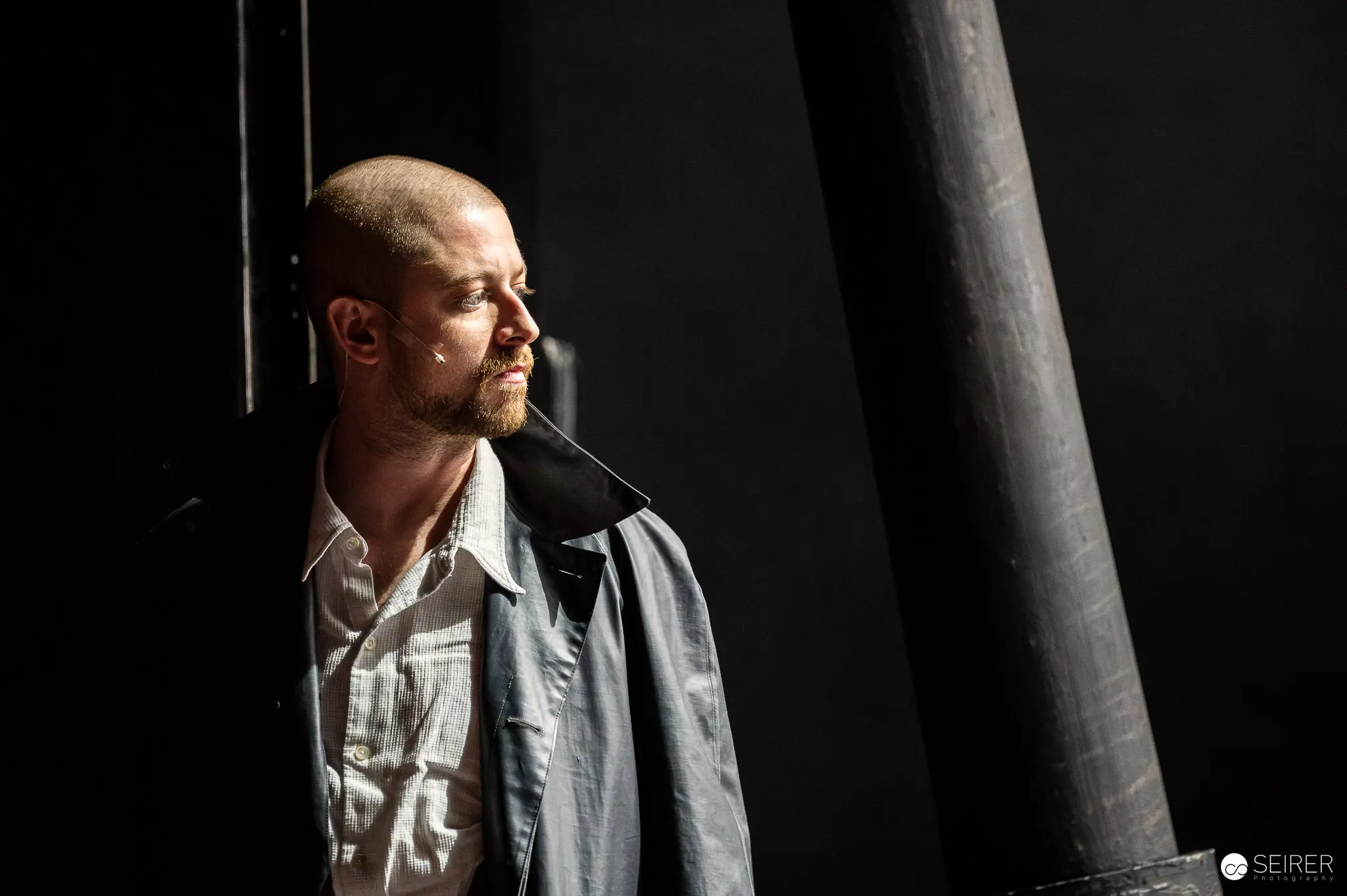 "Leben und Sterben in Wien" Theater in der Josefstadt, 2024 A male performer stands in profile within a dramatically lit space, illuminated by a single shaft of natural light entering from the right side of the frame. He wears a light-colored shirt beneath a grey-blue jacket, his gaze directed toward the light source, creating a contemplative atmospheric quality. The stark contrast between the brightly lit figure and the deep shadows of the surrounding theatrical space emphasizes the chiaroscuro effect characteristic of the production design by Die Schichtarbeiter for "Leben und Sterben in Wien" at Theater in der Josefstadt. The composition suggests a moment of introspection within Thomas Arzt's historical drama set in interwar Vienna.
 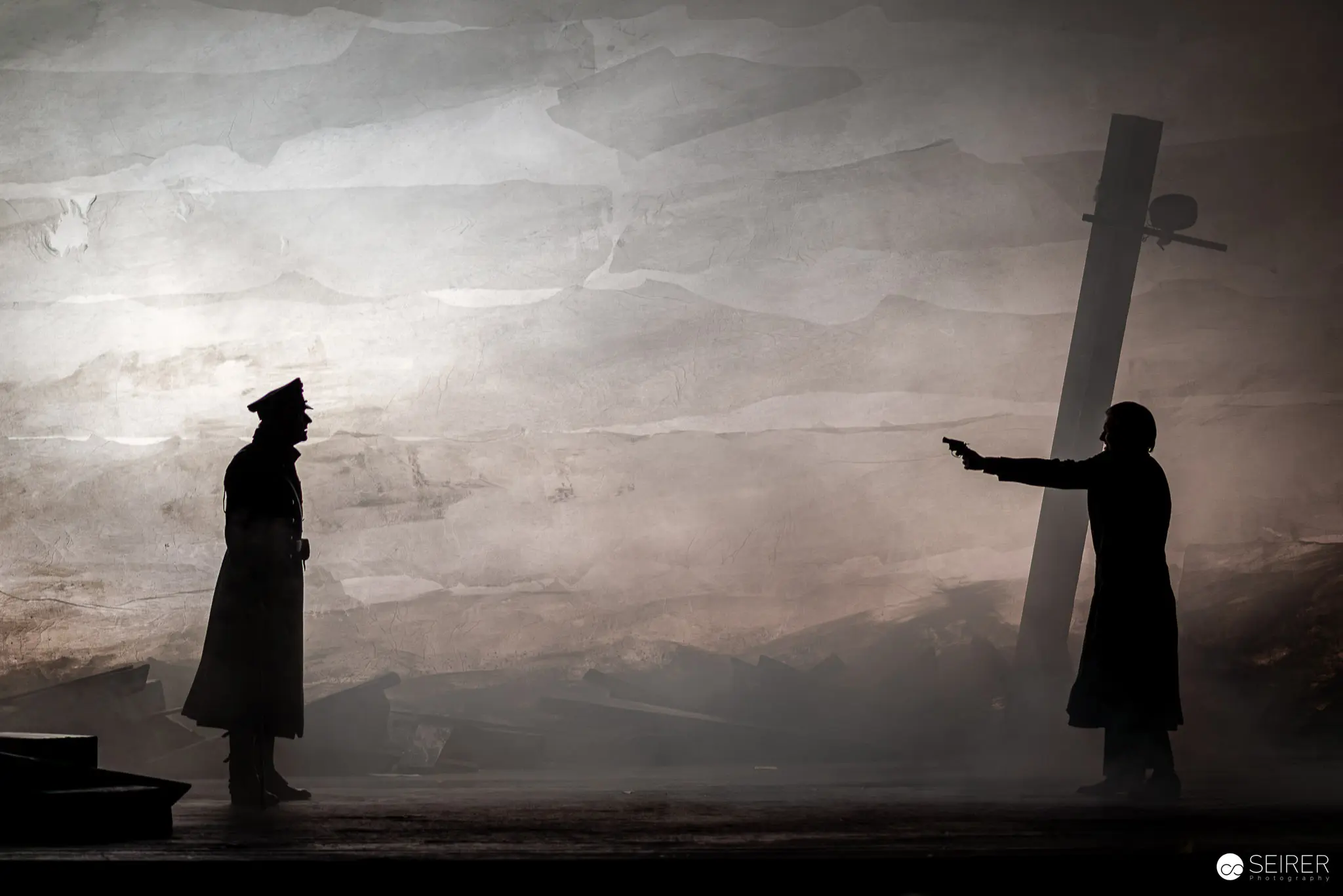 "Leben und Sterben in Wien" Theater in der Josefstadt, 2024 Two silhouetted figures occupy opposite sides of the stage against a dramatically lit clouded backdrop at Theater in der Josefstadt's 2024 production of *Leben und Sterben in Wien*. The figure at left, positioned on steps, wears a military greatcoat and peaked cap characteristic of interwar Austrian forces, while the figure at right stands before a large cross, arm extended in a gesture suggesting confrontation or judgment. The atmospheric lighting design by Die Schichtarbeiter creates dense theatrical fog that diffuses through the scene, emphasizing the ideological chasm between the characters in this production directed by Herbert Föttinger, which dramatizes the political polarization of 1920s-30s Vienna.
 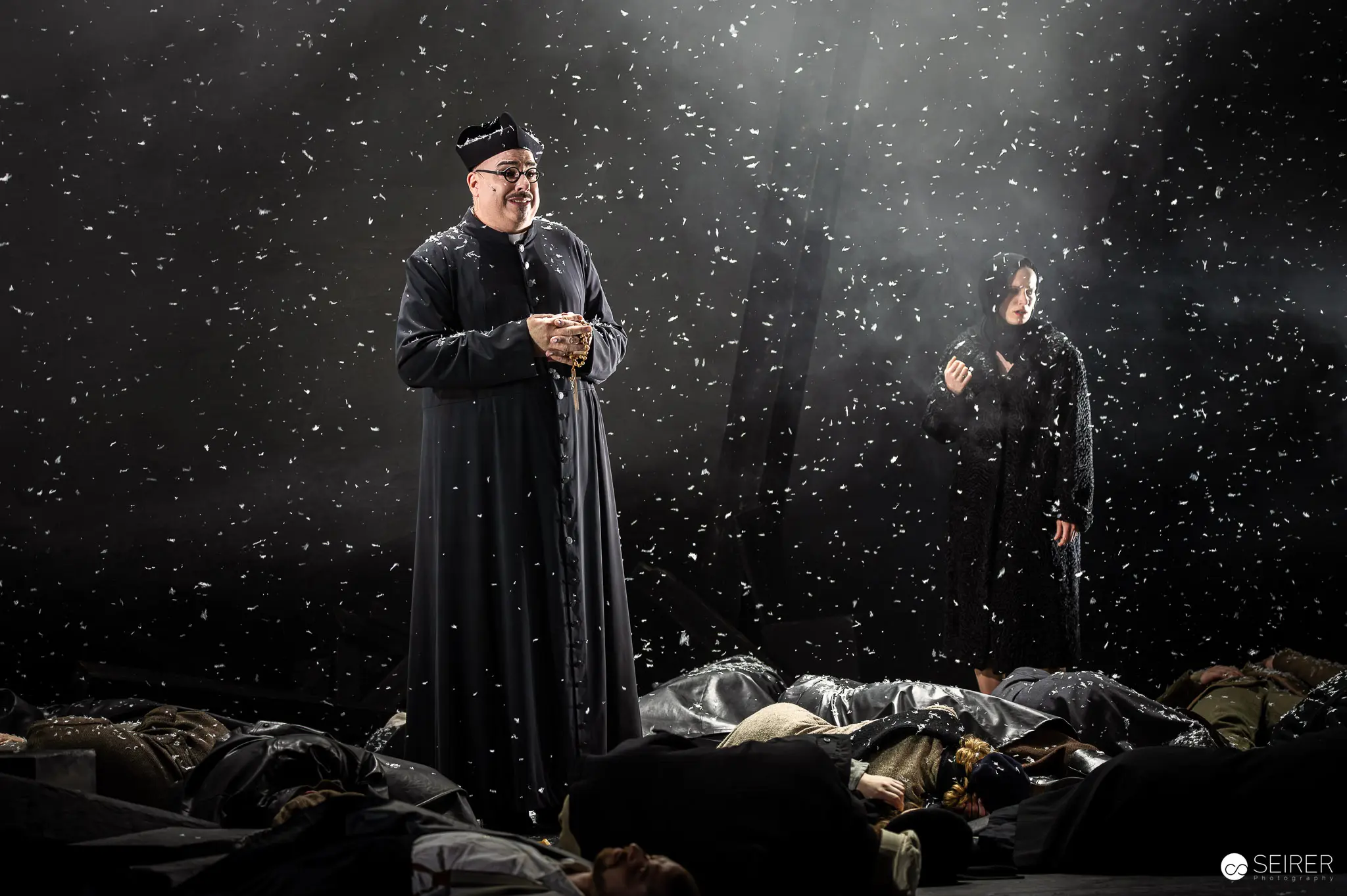 "Leben und Sterben in Wien" Theater in der Josefstadt, 2024 A priest in black robes and biretta stands center-left in the theatrical space, hands clasped in prayer, while a second figure in dark clothing stands at right, both illuminated by scattered particles suggesting falling snow or ash against a dark backdrop. At their feet lie multiple bodies arranged across the stage floor, dressed in period clothing, creating a tableau of mass death or casualties. The stark lighting creates dramatic contrast between the standing religious figures and the horizontal forms below, evoking the violence and tragedy of Vienna's interwar political conflicts in this production of Thomas Arzt's *Leben und Sterben in Wien*, directed by Herbert Föttinger at Theater in der Josefstadt.
 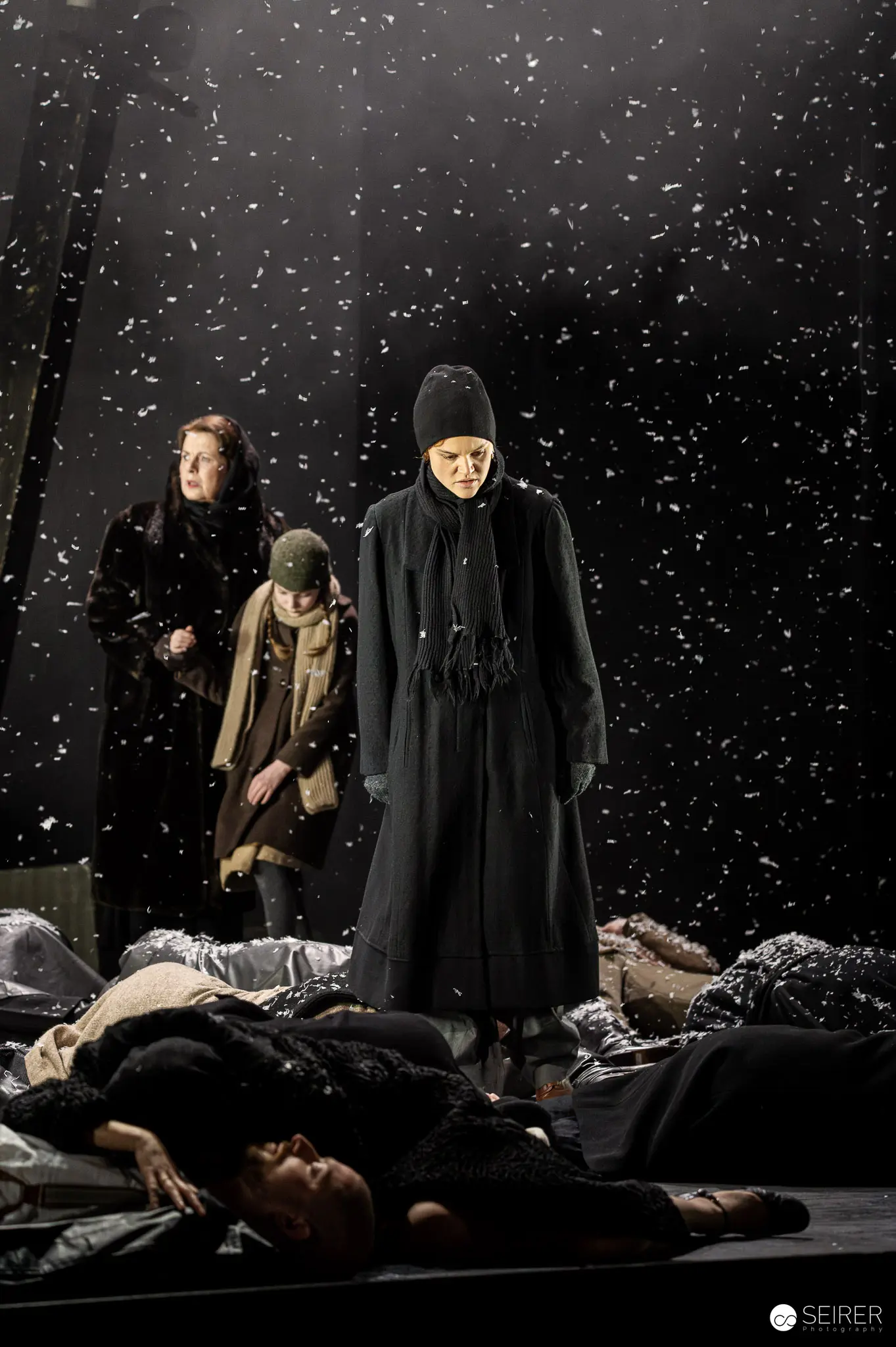 "Leben und Sterben in Wien" Theater in der Josefstadt, 2024 A stark theatrical tableau depicts three figures standing amid bodies strewn across a darkened stage, illuminated by falling snow or ash against a black backdrop. Center stage, a figure in black clerical robes, identified as Robert Joseph Bartl portraying the Priest, dominates the composition, flanked by two other performers in period costume. The scene represents a climactic moment from Thomas Arzt's "Leben und Sterben in Wien" at Theater in der Josefstadt, directed by Herbert Föttinger, with the prone figures and atmospheric precipitation creating a visual metaphor for the social devastation of interwar Vienna's political violence.
 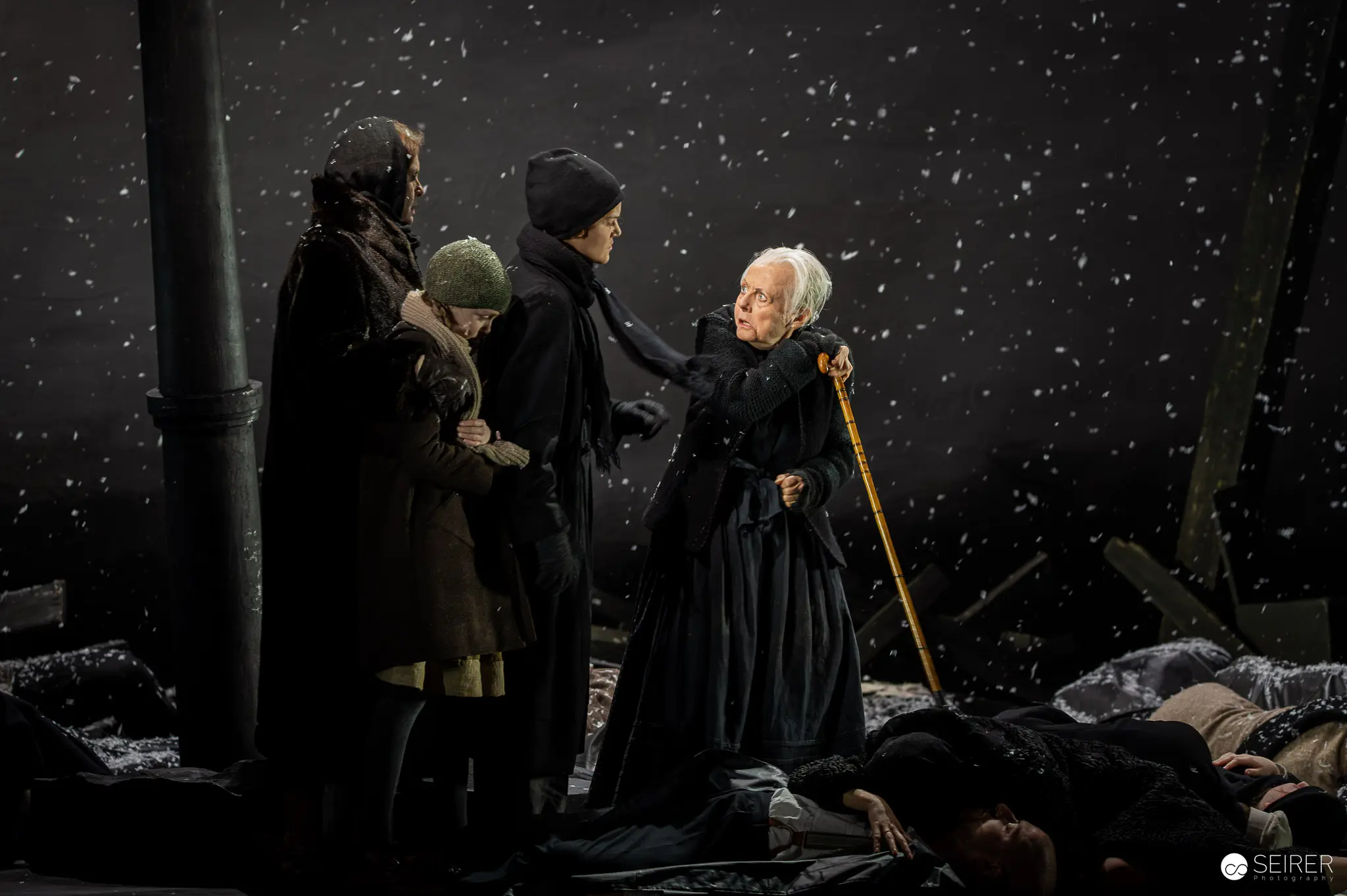 "Leben und Sterben in Wien" Theater in der Josefstadt, 2024 In a stark snowfall against a dark backdrop, four figures in black period costumes stand among bodies strewn across the stage floor, creating a tableau of aftermath and desolation. At right, an elderly woman with white hair and walking stick—Lore Stefanek as Die Alte—confronts three other characters, their postures suggesting confrontation or judgment amid the casualties of violence. The composition, with its vertical pillar at left and scattered corpses below, evokes the physical and moral devastation of interwar Austrian civil conflict. Herbert Föttinger's staging employs minimalist scenography by Die Schichtarbeiter, with controlled theatrical snow and harsh lighting emphasizing the brutal consequences of political radicalization central to Thomas Arzt's *Leben und Sterben in Wien*.
 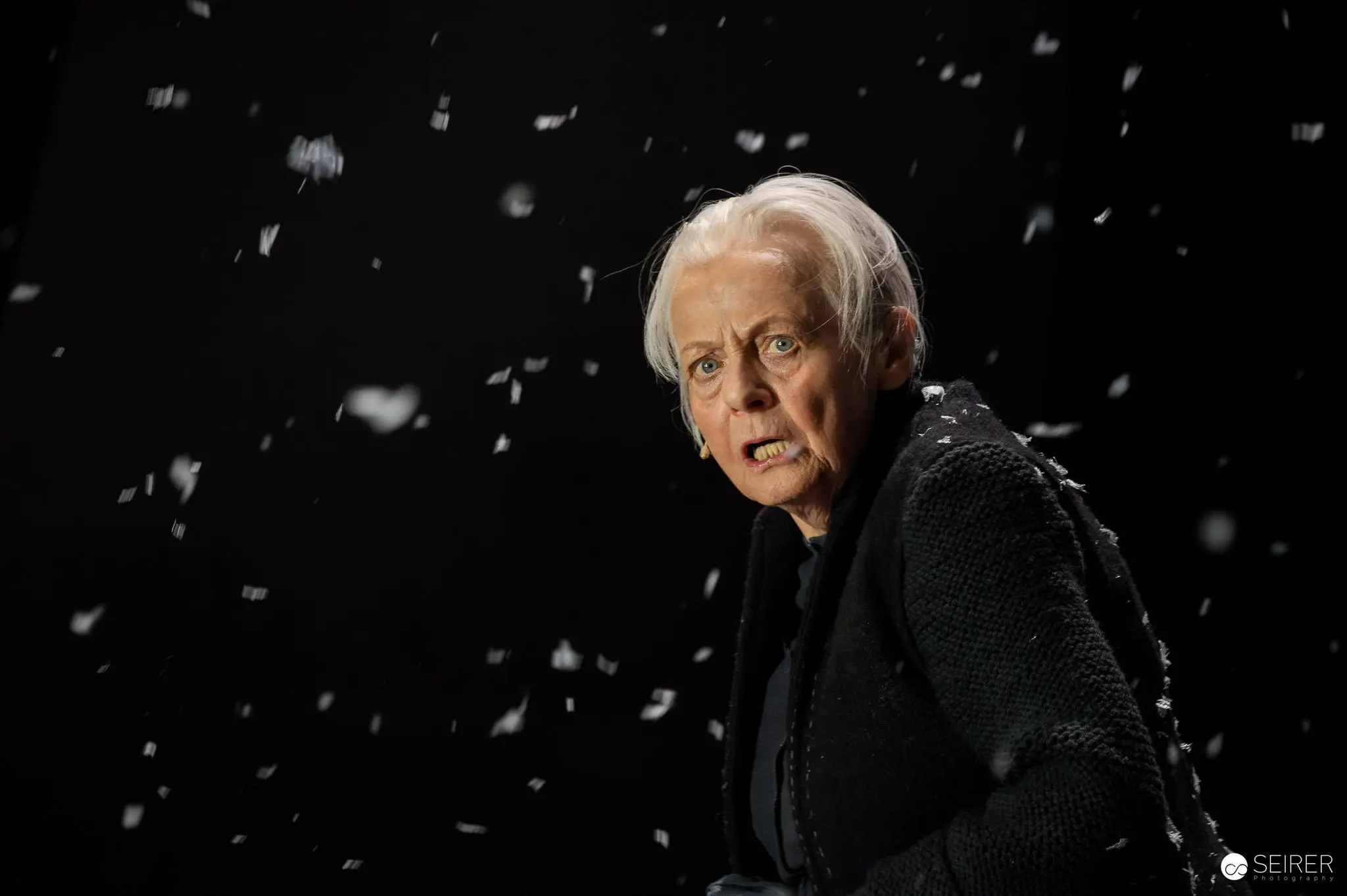 "Leben und Sterben in Wien" Theater in der Josefstadt, 2024 An older performer in dark woolen garments stands in profile against a black background, their face turned toward the camera with an expression of concern or apprehension. White paper fragments fall through the theatrical space, creating a diagonal pattern across the composition that suggests disintegration or dissolution. The dramatic side lighting emphasizes the subject's features and the texture of the costume, while the stark contrast between figure and void reinforces the production's austere visual aesthetic. This scene from "Leben und Sterben in Wien" at Theater in der Josefstadt, directed by Herbert Föttinger with stage design by Die Schichtarbeiter, employs this falling-paper motif to evoke the fractured social landscape of interwar Vienna.
 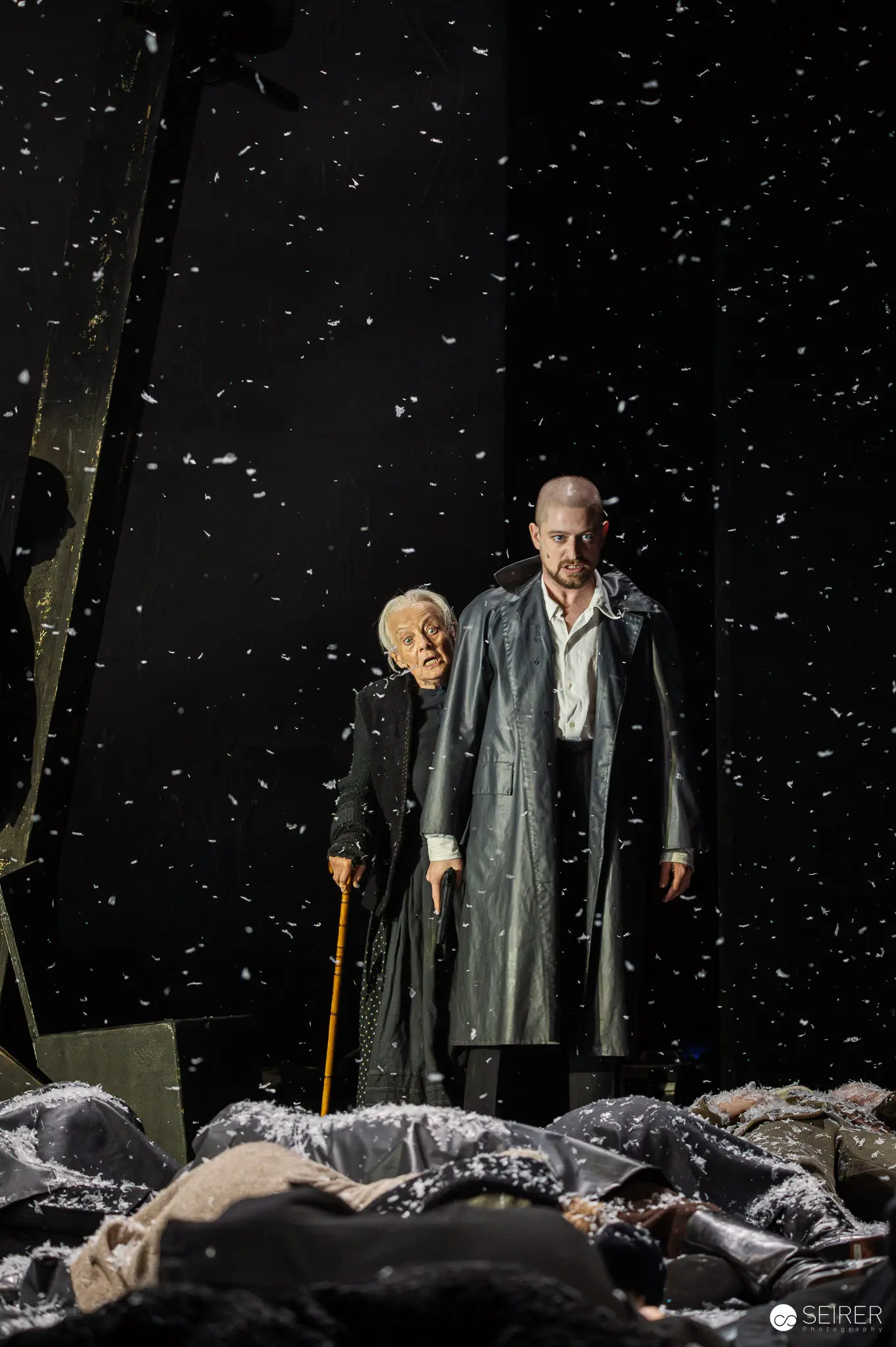 "Leben und Sterben in Wien" Theater in der Josefstadt, 2024 A lone figure in a long coat stands center stage holding a skull, evoking Hamlet's iconic gesture, while artificial snow falls against a black void. The theatrical mise-en-scène features rough stone or rubble formations scattered across the stage floor, creating an apocalyptic landscape. The stark lighting isolates the performer against the darkness, emphasizing the existential contemplation at the heart of this 2024 Theater in der Josefstadt production of Thomas Arzt's interwar Vienna drama. The snow effect and desolate staging reinforce the play's themes of mortality and social collapse during Austria's turbulent Zwischenkriegszeit period. Directed by Herbert Föttinger with stage design by Die Schichtarbeiter.
 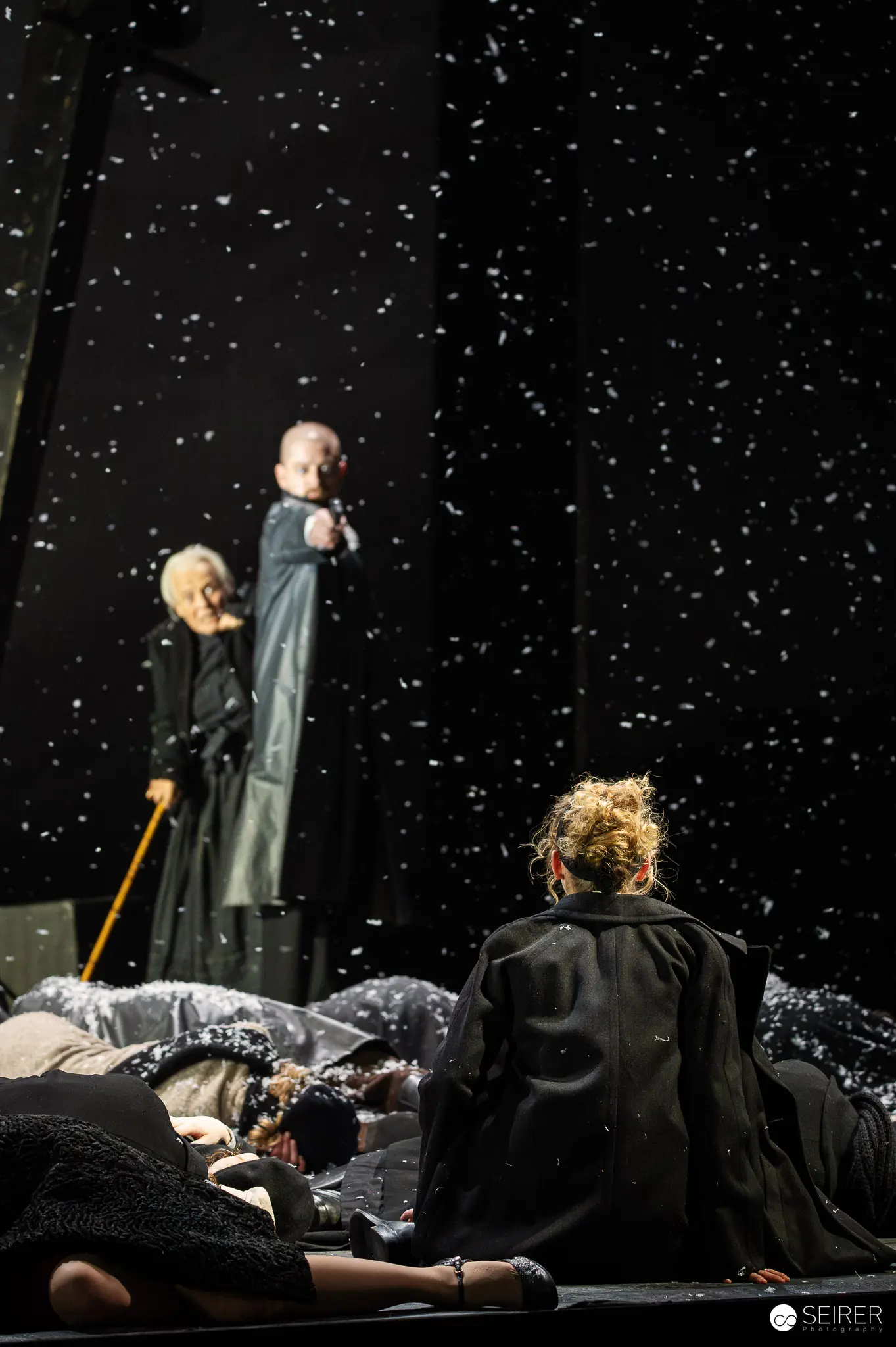 "Leben und Sterben in Wien" Theater in der Josefstadt, 2024 A theatrical tableau shows multiple bodies in dark period costumes arranged across the stage floor beneath a starfield backdrop, suggesting a scene of death or aftermath. Two standing figures appear in the mid-ground—puppets or effigies manipulated against the night sky—while a seated performer in dark clothing is positioned in the foreground right. The compositional arrangement, photographed from an elevated angle, creates a stark visual memorial echoing the interwar violence central to Thomas Arzt's *Leben und Sterben in Wien*, directed by Herbert Föttinger at Theater in der Josefstadt in 2024. The snow-like particles scattered across the scene reinforce the production's exploration of mortality and historical trauma.
 You might also like
- Backstage im Theater in der Josefstadt Blog
- "Der Bauer als Millionär" in der Josefstadt (Theaterfotografie) Blog
- Die unsichtbare Kunst der Theaterfotografie: Was man hinter den Kulissen lernt Blog
- Backstage at the Volkstheater Vienna Blog
- Behind the scenes: Kammerspiele Wien Blog
- 2023-11-14 Bis nächsten Freitag - Peter Turrini - Josefstadt Gallery
- 2024-01-09 Peter Turrini "Es muss geschieden sein" in der Josefstadt Gallery
- 2024-10-07 Josefstadt Biedermann und die Brandstifter Gallery
- 2025-05-19 Das Weite Land - Josefstadt Gallery